
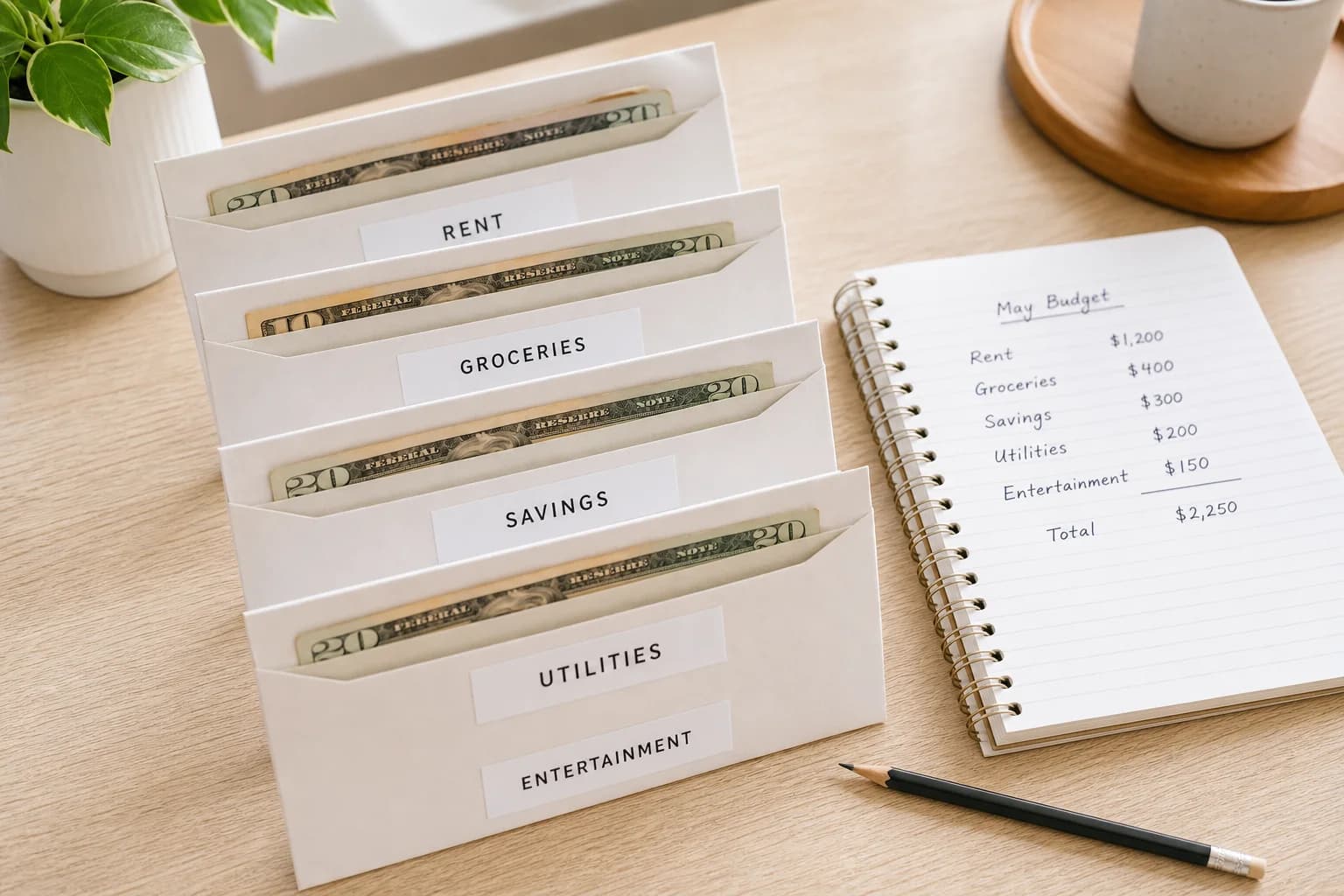
Cash stuffing divides physical cash into labeled envelopes for specific spending categories. What looks like a viral TikTok trend is actually a centuries-old budgeting method that makes spending feel real. This guide covers how to start the cash stuffing method, which categories work best, safety tips, and modern hybrid alternatives for people who prefer not to carry cash.
Cash stuffing is a physical budgeting method where you withdraw a set amount of cash at the start of each pay period and divide it into envelopes labeled with specific spending categories. Each envelope represents a hard limit. When the cash inside is gone, you stop spending in that category until the next cycle.
<3>The Basics in 60 SecondsHere is how it works: you allocate a portion of your income to each spending category, withdraw that amount in cash, and store it in a labeled envelope. Throughout the month, you pay for things using only the cash in the relevant envelope. No credit cards. No rounding up. Just physical bills leaving your hand.
<3>Why Gen Z Is Rediscovering ItThe hashtag #CashStuffing has generated over 800 million views on TikTok. The appeal is simple: in an era of invisible digital payments, handing over a $20 bill for groceries feels painful in a way that tapping a card never does. That physical discomfort is intentional. It creates genuine accountability for your spending choices.
<3>It Is Not NewThe envelope budgeting system dates back to the 1970s and was popularized by financial coaches like Dave Ramsey as part of his baby steps. What is new is the audience: a generation that grew up on digital payments and BNPL plans is turning back to cash because it adds friction to spending decisions in a way that swiping a card does not.
<2>How to Start Cash Stuffing — Step-by-StepStarting is straightforward. Follow these steps in order, and you will have a working system within one pay cycle.
<3>Step 1: Pick Your CategoriesLess is more when you are starting out. Choose 4-6 spending categories where you tend to overspend or want more control. Common starting categories are groceries, dining out, entertainment, gas, personal care, and miscellaneous. Fixed expenses like rent, utilities, and debt payments do not go in envelopes. Those are already covered in your regular budget.
<3>Step 2: Set Your Envelope LimitsLook at your last 2-3 months of spending in each category and find your average. Set that number as your envelope limit, your realistic ceiling not your target. For your first month, err on the side of slightly more than you think you need. Adjust downward next month once you have real data.
<3>Step 3: Get Your SuppliesYou need envelopes (paper or plastic wallet-style), a way to organize them (a binder with pockets, an accordion file, or a small cash box), and a secure storage plan at home. Paper envelopes work fine and are inexpensive. Plastic wallet-style envelopes with clear pockets are more durable and reusable. Dedicated cash stuffing binder systems cost $15-$40. Not necessary, but some people find the structure helpful.
<3>Step 4: Withdraw on Payday — Then Go Straight HomeTiming matters. Withdraw your allocated cash on payday and go directly home or to your secure storage location. Do not stop for groceries, coffee, or anything else. The moment you deviate, you introduce opportunity for the cash to get mixed up or spent informally. Get the cash home, get it into envelopes, and get it stored before you spend anything.
<3>Step 5: Stuff the EnvelopesWrite the category name and budget amount on each envelope. Count the cash twice to confirm the amount. Record the starting balance somewhere, a notebook page, a note on your phone, or a printed tracking sheet. This record is your baseline for the month.
<3>Step 6: Spend From Envelopes OnlyThis is the rule that makes or breaks the system: when an envelope is empty, you stop spending in that category for the rest of the pay cycle. No borrowing from another envelope. No telling yourself you will make it up next month. If you need help tracking what is left in real time, this guide on how to track expenses has a simple daily logging habit that works well alongside cash stuffing.
<3>Step 7: Handle LeftoversAt the end of the pay cycle, any cash left in an envelope is yours to decide. Options: roll it over into the same category next month, transfer it to your savings, or put it toward a debt payoff goal. Rolling over for 2-3 months builds a cushion in each category, which reduces panic when an unexpected expense comes up.
<2>Does Cash Stuffing Actually Work?The short answer: yes, for most people. Understanding why it works helps you decide whether this method belongs in your financial toolkit.
<3>The Psychology Behind ItResearch consistently shows that people spend 12-18 percent less when using cash versus plastic. The reasons are rooted in behavioral economics: the pain of paying is more visceral when a physical bill changes hands. Digital transactions feel abstract, numbers on a screen. Cash is tangible, finite, and irreplaceable. Once it is gone, it is gone. That physical constraint is what makes the envelope system effective for people who struggle with overspending.
<3>Who It Works Best ForCash stuffing tends to work best for people who: struggle to track where money goes each month, feel disconnected from their spending because everything is digital, have specific problem spending categories like dining out or impulse purchases, want a visual and tactile way to manage money, or are in debt payoff mode and need strict spending guardrails.
<3>Who Should Think TwiceCash stuffing is not for everyone. Consider a different approach if you: rely heavily on online shopping, share household expenses with a partner who is not on board, live in areas with limited ATM access, work in cash-heavy industries where income is variable, or feel anxious carrying significant amounts of cash. The hybrid section below covers modern adaptations that may fit your life better.
<3>What Research SaysA 2022 study from the University of Kansas found that households using cash-based budgeting systems reported lower financial stress and higher rates of savings goal achievement compared to digital-only budgeters. The key finding: physical money creates a stronger cognitive link between spending and consequence, leading to more deliberate purchasing decisions. The full study is available on the University of Kansas economics department website.
<2>Cash Stuffing Categories — What Envelopes Should You Have?Choosing the right categories is one of the most important decisions in the system. Below are recommended starting envelopes with typical budget ranges. Adjust based on your actual income, location, and spending patterns.
- Groceries ($300-$450 single / $600-$900 family): Food purchased at supermarkets, farmers markets, and convenience stores for home cooking.
- Dining Out ($100-$200 single / $200-$400 family): Restaurants, coffee shops, takeout, food delivery. Tends to be the biggest budget leak for most households.
- Entertainment ($75-$150 single / $150-$300 family): Movies, streaming services, concerts, games, hobbies, and recreational activities.
- Gas ($100-$200 single / $200-$350 family): Fuel for vehicles. If you use public transit, replace with a transit category.
- Personal Care ($40-$80 single / $80-$150 family): Haircuts, toiletries, skincare, cosmetics, gym memberships.
- Miscellaneous ($50-$100 single / $100-$200 family): Everything else: gifts, unexpected small purchases, household items not covered elsewhere.
These are starting points, not rules. You may also want to add envelopes for specific goals: a vacation fund, a holiday shopping envelope, or an emergency car repair envelope. Once your base system is running smoothly, add goal-based envelopes one at a time.
<2>Common Cash Stuffing Challenges — And How to Solve ThemEvery cash stuffer runs into friction at some point. Here are the six most common challenges and practical solutions.
<3>Challenge 1: I Ran Out of Cash Mid-MonthThis is usually a sign that your envelope allocation does not match your actual spending patterns. Track every cash purchase for a month without changing your behavior, then adjust envelope amounts based on real data. If dining out keeps running dry, either allocate more to that envelope or genuinely reduce dining-out occasions.
<3>Challenge 2: Carrying Cash Makes Me NervousSecurity anxiety is valid. Never carry more than one or two envelope amounts at a time. Leave the rest in your locked storage at home. Take only what you need for the specific outing. If you are going to the grocery store, bring just the groceries envelope.
<3>Challenge 3: What About Online Purchases?Online shopping is the biggest gap in a pure cash system. Solutions: set up a separate debit card funded only by your miscellaneous or entertainment envelope for the month. Or remove credit card information from shopping apps and only complete online purchases on a device you do not use daily. Some cash stuffers keep a small amount in a PayPal or Venmo account specifically funded by their miscellaneous envelope.
<3>Challenge 4: My Partner Does Not Want to Use CashA two-person system requires buy-in from both partners. Start with one category both of you agree on. Dining out is usually the easiest. See if the person who resists the most notices a difference in their spending awareness after one month. Frame it as an experiment, not a permanent overhaul. Couples who budget together often find it easier to hit savings goals.
<3>Challenge 5: I Keep Forgetting My Envelopes at HomeBuild a habit by attaching your envelope routine to an existing habit. Keep your envelopes in your wallet or bag, not in a separate location. Every payday, do a five-minute envelope check: Are they in my bag? Do I have the amounts I need for this week? Pair it with another routine like getting gas, paying a specific bill, or your morning coffee.
<3>Challenge 6: ATM Fees Are Eating My BudgetATM fees can quietly eat 2-3 percent of your cash budget. Use a bank or credit union that reimburses ATM fees, or find a bank with fee-free ATMs near your home or workplace. Withdrawing once per pay cycle, not multiple times, also reduces fee exposure. Many people find that the savings from reduced discretionary spending far outweigh ATM costs within the first month.
<2>A Real Example: How Min-ji Made It WorkMin-ji, a 26-year-old graphic designer in Kuala Lumpur, started cash stuffing in January after her credit card bills kept surprising her. She created five envelopes: groceries at 400 ringgit, dining out at 180 ringgit, transport at 90 ringgit, entertainment at 80 ringgit, and miscellaneous at 100 ringgit. By the third month, she had rollover cash in every envelope and had paid off 2,400 ringgit of credit card debt she had been carrying for months. I did not realize how much I was actually spending on lunch and coffee until I could see it leaving my hand, she said. The physical act of handing over money made every purchase feel more real.
<2>Hybrid Cash Stuffing — Modern Adaptations for 2026If carrying cash gives you anxiety, or if your life requires frequent online purchasing, you do not have to go all-in on physical envelopes. Here are four hybrid approaches that keep the accountability principle while working with modern spending patterns.
<3>Option 1: Digital Envelope AppsApps like Goodbudget, Mvelopes, and YNAB use the envelope philosophy but apply it to digital money. You allocate amounts to virtual category envelopes and track spending against those limits. YNAB is particularly popular with the FIRE (Financial Independence, Retire Early) community and has strong educational content. These apps are excellent if you want the framework without the physical cash.
<3>Option 2: Cash for Problem Categories OnlyOnly use cash for the 1-2 categories where you demonstrably overspend. If dining out is your budget killer, take that envelope cash and leave everything else digital. This targeted approach is less disruptive to daily life while still creating a physical spending constraint where it matters most.
<3>Option 3: Debit Card EnvelopesSome banks and neobanks let you create multiple sub-accounts or virtual debit cards linked to different spending pots. You can allocate a set amount to a virtual envelope each payday and use the associated card for purchases in that category. This gives you digital convenience with category-level spending visibility.
<3>Option 4: Cash Plus Rewards OptimizationIf you have a rewards credit card you pay off in full every month, use it for categories where cash does not make sense (utilities, online subscriptions, fixed bills) and reserve cash for discretionary categories where the tactile spending experience helps you spend less. You get the psychological benefit of cash budgeting while not leaving credit card rewards points on the table.
<2>Safety and Security — Protecting Your CashCarrying and storing cash comes with real security considerations that digital payments do not have. Here is how to protect your money without turning it into a source of anxiety.
<3>At HomeStore your envelopes in a locked drawer, a small safe, or a location that is not obvious to visitors. Do not keep the full month's cash at home if your home has any security concerns. Some people prefer to keep only 1-2 weeks of cash at home and withdraw the rest partway through the month.
<3>On the GoCarry only the envelope you need for a specific trip. Leave the rest at home. If you must carry larger amounts, use an under-clothing money belt or a front-pocket wallet rather than a back pocket or a bag. Be mindful in crowded places, at ATMs, and when paying in environments where others can see how much cash you have.
<3>At the BankUse bank ATMs when possible rather than standalone ATMs, which are more vulnerable to skimming. If you are withdrawing a large amount, bring someone with you or vary your routine. Some people split withdrawals across two different visits or ATM locations to reduce exposure.
<3>If Cash Is Lost or StolenCash is irreplaceable in a way that digital funds are not. If an envelope is lost or stolen, treat it as a budget loss for that category. Do not immediately refill it from another source. File a police report if theft is involved. Review your security habits and adjust. Building a small rollover cushion in each envelope (2-3 weeks extra) helps absorb these occasional losses without derailing your entire month.
<2>FAQ — Cash Stuffing Method- Does cash stuffing actually work?
- Yes, for most people. Cash spenders consistently spend 12-18 percent less than digital spenders. The physical sensation of handing over money creates a psychological barrier that digital payments bypass.
- What envelopes should I start with?
- Start with 4-6 envelopes maximum. The most common starting set: Groceries, Dining Out, Entertainment, Gas, and Miscellaneous. These cover the variable spending areas most people want to control.
- Is cash stuffing safe?
- Carrying cash has manageable risks. Never carry more than you need for a specific outing, store cash securely at home, use bank ATMs rather than standalone machines, and do not flash large amounts in public.
- Can I cash stuff if I shop online a lot?
- Yes, with adaptations. Use a dedicated debit card funded by your miscellaneous or entertainment envelope for online purchases. A hybrid system works well for most people.
- What if I run out of cash before the month ends?
- Stop spending in that category until the next pay cycle. Do not borrow from another envelope. Track your actual spending for a month and adjust envelope amounts accordingly.
- Do I need a special binder for cash stuffing?
- No. A standard paper envelope and a simple organizer work perfectly well. Dedicated cash stuffing binders exist and some people find them helpful, but they are not required.
- How often should I withdraw cash?
- Most people withdraw once per pay cycle, on payday. This matches the rhythm of allocating money to envelopes and reduces the temptation to withdraw opportunistically throughout the month.
- Can couples do cash stuffing together?
- Yes, but it requires communication. Start with one shared category both partners are comfortable using cash for. Both people need to understand the rule: when the envelope is empty, spending stops for that category.
- What denomination bills should I request?
- Ask for a mix of $20s and $10s for most categories. $20s are the most versatile. For smaller categories like personal care, $10s and $5s are useful. Avoid keeping too many $100s on hand.
- Should I roll over leftover cash or spend it?
- For the first 2-3 months, roll over leftovers to build a cushion of 2-3 weeks extra in each category. Once you have that cushion built, redirect rolled-over cash to savings goals or debt payoff.
The cash stuffing method is not a magic solution and it is not for everyone. But for people who feel disconnected from their spending, struggle to stick to digital budgets, or want a simple visual way to manage money without apps or spreadsheets, it is one of the most effective tools available. The physical act of allocating, stuffing, and spending from envelopes creates a feedback loop that most digital systems cannot replicate. Start small with 4-6 categories, give yourself one full month before judging results, and be honest with yourself about whether the friction of physical cash is a feature or a dealbreaker for your lifestyle.
If you found this guide useful, you might also like our article on how to budget with irregular income, which covers how to apply envelope-style thinking to income that fluctuates month to month. For couples, our guide on how to budget as a couple with different incomes explains how to align on shared financial goals even when your earning patterns differ. Building an emergency fund is another critical piece of a complete financial plan, and our sinking fund guide explains how to save for future expenses without derailing your budget.
Take control of your money today
Start free with Spendmate — track expenses, plan budgets, and reach your financial goals.
Start free with Spendmate