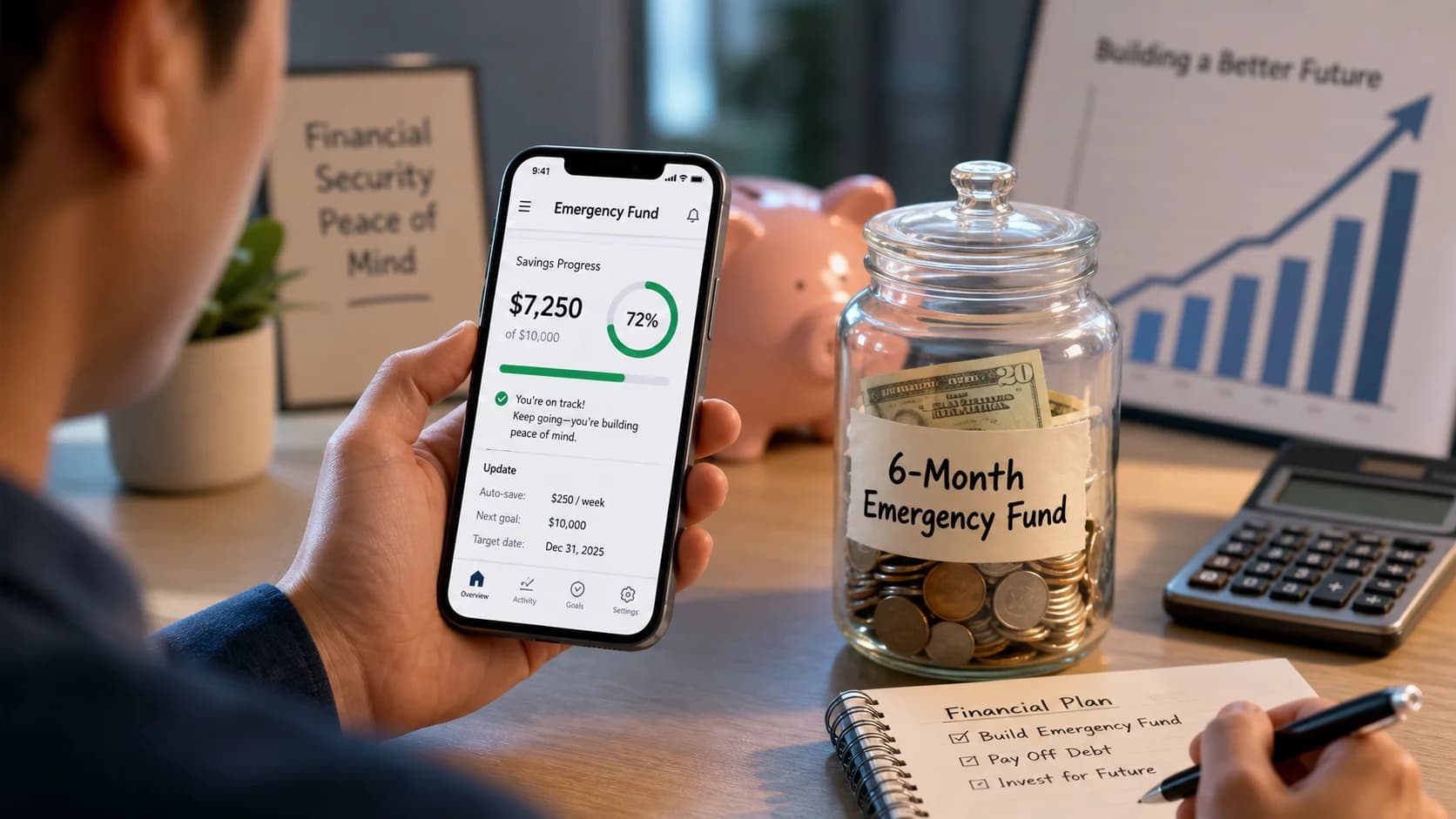
Only 44% of Americans could cover a $1,000 emergency with savings in 2025. That means 56% of us — more than half — are one flat tire, one ER visit, or one layoff away from financial disaster. Every financial advisor says you need a 6-month emergency fund. What they rarely tell you is exactly how to build one without earning six figures. This guide does. You will learn how much you personally need, the 5-phase plan to get there, where to keep the money, and how to avoid the mistakes that stop most people cold. By the end you will have a working system — not just advice, but a clear path from where you are to fully funded. Written by the Shoninfox editorial team.
<2>What Is a 6-Month Emergency Fund (And Why 6 Months?)A 6-month emergency fund is six months of essential living expenses set aside in a liquid, accessible account. It is not six months of income — it is six months of what you need to survive: housing, utilities, groceries, transportation, minimum debt payments, insurance, and healthcare. Dining out, streaming, vacations: not included. The 6-month target covers the average American job search (5–6 months in 2026 per the Bureau of Labor Statistics), gives you breathing room during recessions, and lets you make calm decisions instead of desperate ones. If you are dual-income with stable jobs, 3 months may suffice. If you are freelance, commissioned, or self-employed, aim for 9–12 months. If you are just starting out, check out our guide on how much emergency fund you actually need to calculate your personal number. Building an emergency fund works best when paired with a zero-based budgeting approach — give every dollar a job, then redirect the surplus toward your fund.
"The single biggest financial regret I hear from people in their 40s and 50s is not starting an emergency fund earlier. Not investing mistakes. Not bad stock picks. Just not having a cash cushion when something went wrong." — CFP Board, Financial Advisor Standards Board, 2025<2>How Much Is 6 Months of Expenses? (Calculate Your Number) <3>Essential Expenses Only (Not Your Full Budget)
Most people overestimate their emergency fund target because they include discretionary spending. Your emergency fund covers what you need to survive, not what you enjoy. Use this worksheet to calculate your actual number. List each expense category, estimate your monthly cost, and multiply by 6. The result is your 6-month emergency fund target.
- Rent or mortgage (PITI: principal, interest, taxes, insurance)
- Utilities (electricity, water, gas, internet, phone)
- Groceries (essential food only, not dining out)
- Transportation (car payment, gas, insurance, public transit pass)
- Minimum debt payments (credit card minimums, student loan minimums, car payment)
- Health insurance premium
- Essential healthcare (prescriptions, copays for ongoing conditions)
- Essential insurance (renters or homeowners insurance, life insurance)
- Other non-negotiable expenses (child support, alimony)
Skip these from your emergency fund math: dining out, entertainment, streaming, gym memberships, travel, holiday gifts, and any discretionary spending. Be ruthlessly honest — padding your number makes the goal feel impossible before you begin.
<3>Real-World Examples (2026 US Costs)Here is what 6 months of essential expenses actually looks like across different American households in 2026. These are not worst-case scenarios — they are median estimates based on current cost-of-living data.
- Single renter, no car, city-based, $50K income: $13,200 target ($2,200/month essentials)
- Single person, car payment, $60K income: $16,800 target ($2,800/month essentials)
- Couple renting, one car, $80K combined income: $22,800 target ($3,800/month essentials)
- Family of 4, mortgage, two cars, $100K combined income: $33,000 target ($5,500/month essentials)
- Family of 4, mortgage, single income earner, $120K income: $37,200 target ($6,200/month essentials)
If you set your emergency fund target in 2020, it probably needs a refresh. Cumulative inflation from 2020 to 2026 pushed essential costs up 29–43%, depending on location and category. A single person who needed $10,800 in 2020 now needs roughly $14,000–$15,500 for the same lifestyle. A family of 4 who targeted $25,000 in 2020 may now need $32,000–$36,000. Review your target annually or after any major life change. Bump it up 2–4% each year to keep pace with rising costs — this is one adjustment the BLS cost-of-living data makes easy to track.
Building a 6-month emergency fund from zero feels enormous. The solution: break it into five concrete phases. Each milestone builds real momentum for the next. Do not rush, but do not stall either. Consistency is what turns a distant goal into a fully funded account. If you need help finding surplus income to accelerate this process, our side hustle income budgeting guide has practical ideas that actually bring in money.
<3>Phase 1 — Baby Emergency Fund ($1,000–$2,000) [Month 1–2]Your first milestone is modest but real: $1,000–$2,000. This covers the emergencies most Americans actually face — a flat tire ($150), an ER copay ($250), a broken appliance ($300–$800), a minor car repair ($500). These are the surprises that drive people to credit cards. Hitting this milestone puts you ahead of 44% of Americans who cannot cover a $1,000 expense at all. To get there fast: sell unused items on Facebook Marketplace or eBay, pick up a side gig on weekends, or cut one discretionary subscription. For a structured approach to finding money to save, see our budgeting for beginners guide — even small behavioral changes compound quickly. Speed matters more than yield at this stage. Put every dollar in a separate savings account you will not touch.
<3>Phase 2 — 1 Month of Expenses [Month 3–5]Now scale up to one full month of essential bills. Automate a weekly or biweekly transfer from checking to your dedicated emergency fund — even $50–$100 per week adds up to $200–$400 monthly. Open a high-yield savings account (HYSA) now; rates are 3.5–4.5% APY in 2026, so your money earns something while you build. When you get a tax refund, work bonus, or any windfall, direct 100% of it to the fund until Phase 2 is done. This is the savings avalanche approach — hit one milestone completely before moving on.
<3>Phase 3 — 3 Months of Expenses [Month 6–10]Three months of essential expenses is where most advisors say you are safe enough. The average unemployment spell in the US lasts 3–4 months (BLS data, 2026), and 3 months covers most personal emergencies too. Bump your savings rate to 15–20% of income. Try a no-spend month — essentials only for 30 days — and you can save $500–$1,500 in a single shot depending on your baseline. Keep this fund entirely in your HYSA for liquidity. By the time you hit 3 months, you will have more financial security than most Americans.
<3>Phase 4 — 6 Months of Expenses [Month 11–18]The gold standard: six months of essential expenses. This means you can weather a prolonged job search, a medical crisis, a major home repair, or a family emergency without taking on debt. Maintain your 15–20% savings rate and direct all surplus income to the fund. At this stage, consider splitting it: 80% in your HYSA for immediate access, 20% in a short-term CD ladder (3–6 month CDs at 4.0–5.0% APY) for a modest passive income boost. For a deeper look at where to park this money, our high-yield savings accounts guide breaks down the best FDIC-insured options for emergency funds in 2026. Do not invest your emergency fund in stocks — emergency funds must be protected, not risked.
Reaching 6 months is not the end — it is the beginning of ongoing maintenance. Review your emergency fund every 6 months: has your cost of living changed? Have you moved, changed jobs, gotten married, had a child, or taken on new fixed expenses? Adjust your target upward if expenses increased, or note that you may have surplus if expenses decreased. Every year, increase your target by 2–4% to keep pace with inflation. If you use your emergency fund, treat it as money borrowed from yourself — not spent. Rebuild it as if you are starting from Phase 2 or Phase 3, whichever applies. If you have variable income (freelance, commission, seasonal work), consider overfunding to 7–8 months for added peace of mind.
Reaching 6 months is not the finish line — it is where ongoing maintenance begins. Every 6 months, check whether your cost of living has shifted. Life changes (new job, move, marriage, baby, income change) all affect your target. Adjust upward if expenses grew, downward if they shrank. Bump your target 2–4% annually for inflation. If you tap the fund, treat it as borrowed money — rebuild starting from the phase you were in. Variable income earners should consider funding 7–8 months as a buffer.
<2>Where to Keep Your 6-Month Emergency Fund <3>Best Options (Ranked by Overall Suitability)Your emergency fund has one job: be there when you need it. That means liquidity (accessible within days), safety (FDIC or SIPC insured — no losing money), and a reasonable yield (so it is not losing purchasing power to inflation). Here are the best 2026 options, ranked by suitability for a primary emergency fund holding. For a full breakdown of current rates, see the FDIC's bank find tool at fdic.gov. High-yield savings accounts through banks like Marcus by Goldman Sachs, Ally, SoFi, and Discover are currently offering 3.5–4.5% APY with no minimum balances and FDIC insurance up to $250,000 per depositor.
- High-Yield Savings Account (HYSA): 3.5–4.5% APY, FDIC insured, instant access. Best for 80%+ of your fund. Marcus by Goldman Sachs, Ally, SoFi, and Discover all offer competitive rates with no minimum balances.
- Money Market Account (MMA): 3.5–4.5% APY, FDIC insured, often includes check-writing or a debit card. Best if you want slightly easier access than a traditional savings account.
- No-Penalty CD (12-month): 4.0–4.5% APY, FDIC insured, allows one penalty-free withdrawal. Good for a portion of your fund you are confident you will not need immediately.
- Short-Term CD Ladder (3–6 month CDs): 4.0–5.0% APY, FDIC insured. Ladder maturities so one portion matures every few months. Best for the 20% of your fund you want to optimize for yield.
- Treasury Bills (4-week to 26-week): 4.5–5.0% APY, backed by the US government, liquid in the secondary market. Best for the tax advantage — interest is exempt from state income tax. Vanguard and TreasuryDirect are common purchase platforms.
- Stock market or ETFs — too volatile; your emergency fund could lose 20–40% value exactly when you need it most (during a recession when you might also lose your job)
- Cryptocurrency — extreme volatility and liquidity risk
- Whole life insurance or permanent life insurance — high fees, illiquid, and complex; not designed for emergency access
- Long-term CDs (12 months or longer) — early withdrawal penalties reduce liquidity
- Checking account — 0% interest and too easily accessible for non-emergencies
- Peer-to-peer lending or alternative investments — illiquid and uninsured
Your monthly savings target depends on two things: your 6-month goal and how fast you want to get there. The scenarios below assume a 12–18 month build timeline. Earn less? Your timeline stretches — and that is fine. The real mistake is setting an unrealistic pace and then giving up entirely.
<3>$35,000–$50,000 a Year: Building on a Tight BudgetHere is the honest truth at this income level: $13,000–$17,000 sounds brutal. But saving $600–$800 per month over 18 months is achievable if you treat it like a bill — non-negotiable, auto-drafted the day you get paid. The math works out to a 15–20% savings rate. If that feels impossible from your take-home pay alone, you are probably right. That is why side income matters more than budget cutting at this tier. A weekend side gig at $200–$400 per week can realistically close the gap. No-spend months work well here too — one month of essentials-only spending typically saves $500–$1,500. Use every tax refund and work bonus toward the fund until it is done. Your timeline may be 18–24 months instead of 12. That is not failure. It is normal.
<3>$50,000–$80,000 a Year: The Comfortable MiddleAt this income level, you have enough breathing room to build a solid emergency fund in 12–18 months without side hustles — if you automate it. The moment you "save what is left over," nothing gets saved. Set up a recurring transfer on payday so the money leaves your checking before you can spend it. Pay-yourself-first, in other words. Your target: $17,000–$25,000. Monthly savings needed: $800–$1,200. Windfalls (tax refunds, bonuses, cash gifts) should go 100% to the fund until it is complete. One honest risk here: lifestyle creep. When your income ticks up, the temptation is to upgrade your apartment, car, or dining out budget. Resist that until your emergency fund is fully funded. That discipline is what separates people who weather crises from those who do not.
<3>$80,000–$120,000 a Year: Faster Timeline, Same PrinciplesAt $80K–$120K, you are looking at a 6-month target of roughly $25,000–$37,000. Saving $1,500–$2,500 per month for 10–14 months gets you there — a 20–25% savings rate is very doable here. Before you start saving, do a 3-month spending audit: download your bank and credit card statements and find the subscriptions and charges you forgot about. Cancel three unused services and you have saved roughly $540 per year with zero lifestyle impact. Rate optimization also matters here: the difference between a 3.5% and 4.5% APY on $30,000 is $300 per year — free money for 10 minutes of online banking. Open a high-yield account if you have not already. The biggest risk at this income level is not starting because the number feels too big. Start with $500 this month. It matters more than you think.
<3>Accelerators That Work at Any Income Level- Side hustle income: Direct 100% of freelance or gig earnings to your emergency fund ($300–$800/month average)
- Tax refund: The average 2026 tax refund is $3,000+ — put the entire amount toward your fund
- Work bonus: Allocate 100% of performance bonuses until your fund is complete
- No-spend challenge: 30 days of essential spending only; save $500–$1,500 depending on your normal discretionary spending
- Sell unused items: Declutter your home and sell clothes, electronics, and furniture ($500–$2,000 average haul)
- Expense audit: Cancel three unused subscriptions; save $50–$100 per month with almost no sacrifice
- Cash gifts: Birthday, wedding, holiday money goes 100% to your emergency fund until it is complete
An emergency fund only helps if you use it during genuine emergencies — and resist the urge to spend it on things that are not. Here is how to tell the difference.
<3>Legitimate Emergency Fund Uses- Job loss or layoff (primary purpose of the fund)
- Medical emergency (ER visit, emergency surgery, hospital stay, unexpected serious diagnosis)
- Major car repair ($1,000+ — something you cannot defer)
- Major home repair (roof leak, HVAC failure, plumbing emergency that affects habitability)
- Family emergency (funeral travel, emergency caregiving for a loved one)
- Unexpected legal costs (emergency attorney fees, court-ordered payments)
- Planned expenses (vacation, holiday gifts, home renovation, wedding)
- Credit card debt payoff (use the debt snowball or debt avalanche method instead)
- Car down payment (save for this separately as a sinking fund)
- Wedding expenses (save separately over time)
- "I want to" purchases (this is what your regular budget is for)
- Investing during a market dip (your emergency fund is not an investment vehicle)
- A vacation because you had a bad week at work
Ask yourself four questions before touching the fund: Is it unexpected? Is it urgent? Is it necessary? Is it expensive — more than you can cover from this month's income alone? Yes to all four means it is an emergency. No to any one of them means it is not, and you should budget for it separately.
<2>What If You Cannot Save 6 Months?The 6-month target is an ideal, not a mandate. Life circumstances, income volatility, job security, and health conditions all change what is appropriate. A 3-month fund plus a marketable skill that generates income quickly is more realistic for some people. Dual-income households with stable jobs may genuinely only need 3 months. High-limit credit cards can serve as a temporary 30–60 day bridge while you rebuild — they are not ideal, but they are better than nothing. Whatever you do, do not let "I cannot save 6 months" become an excuse to save nothing. Start with $1,000. Then 1 month. Then 3. Then 6. Any cushion is better than none — $5,000 handles most common emergencies, and $10,000 covers three months for a single person.
- 3-month fund + income generation plan: Three months of expenses plus a marketable skill or side hustle that can generate income quickly if needed
- Dual-income household: Three months may be sufficient if both partners have stable employment and low job-search risk
- Strong family support system: If you have family who can provide financial support in a crisis, 3 months may be adequate
- High-limit credit card as a temporary backup: Not a substitute for an emergency fund, but can bridge a 30–60 day gap while you rebuild
- Home equity line of credit (HELOC): Emergency backup only, not a primary fund — using it risks your home
Start where you are. Use what you have. Do what you can. The journey of a thousand miles begins with a single step.
<2>Common Mistakes to Avoid- Keeping your emergency fund in a checking account: You earn 0% interest and it is too easy to spend accidentally
- Investing your emergency fund in stocks: Risk of loss during a recession coincides exactly with when you might lose your job
- Setting and forgetting: Not reviewing your target for inflation or life changes
- Including non-essentials in your calculation: Overestimating your target makes it feel impossible
- Using the fund for non-emergencies: A vacation or shopping spree because you had a rough month is not an emergency
- Not rebuilding after using it: Treat a withdrawal as borrowing from yourself, not spending — prioritize replenishing immediately
- Waiting until debt-free to start: Build your $1,000–$2,000 baby emergency fund first, then attack debt, then finish the fund
- Comparing your number to someone else: Your target is based on YOUR expenses, not someone else's lifestyle
- Giving up when the target seems too large: Start with $1,000, then 1 month, then 3, then 6 — small wins build momentum
- Not automating savings: Relying on willpower is unreliable; automation makes your emergency fund a non-negotiable expense
- Is 6 months of emergency fund enough in 2026?
- For most people, yes. The average job search in 2026 takes 5–6 months. Six months of essential expenses covers job loss, medical emergencies, and major repairs. If you have variable income (freelance, commission, seasonal work), consider 9–12 months. If you have stable dual income with government or tenured positions, 3 months may be sufficient. Adjust based on your specific job security and expense profile.
- How much does the average American need for a 6-month emergency fund?
- Based on median US household essential expenses ($4,500–$5,500 per month), the average 6-month target is $27,000–$33,000. For a single person, $13,000–$17,000. For a family of 4, $30,000–$40,000. Use the essential expenses worksheet above to calculate your personal target based on your actual costs, not averages.
- Should I invest my emergency fund?
- No. Emergency funds must be liquid (accessible within days) and safe (no risk of loss). High-yield savings accounts (3.5–4.5% APY) or money market accounts are the best options — they pay a competitive yield while keeping your money FDIC insured and instantly accessible. Investing in stocks risks losing value exactly when you need the money most: during a recession when you might also lose your job.
- How long does it take to build a 6-month emergency fund?
- At a 15–20% savings rate, most people can build a 6-month fund in 12–18 months. Lower incomes may take 18–24 months. Accelerate with side hustles, tax refunds, bonuses, and no-spend challenges. The key is consistency — automate your savings so it happens without requiring willpower, and treat it as a non-negotiable monthly expense, not an optional goal.
- What counts as essential expenses for emergency fund calculation?
- Essential expenses are what you need to survive: housing (rent or mortgage), utilities, groceries, transportation, minimum debt payments, health insurance, and essential insurance. Do NOT include: dining out, entertainment, subscriptions, travel, shopping, or any discretionary spending. Your emergency fund covers survival, not lifestyle comfort.
- What if I lose my job before reaching 6 months?
- You are not alone — most Americans have less than 3 months saved. If you lose your job with a partial fund: cut all non-essential spending immediately, apply for unemployment benefits, look for any income (gig work, part-time), use your partial fund strategically for essential bills only, and consider negotiating with creditors for hardship programs. Every dollar you have saved is a dollar that buys you time to find your next job.
- Should I pay off debt or build an emergency fund first?
- Build a $1,000–$2,000 baby emergency fund first, then pay off high-interest debt (credit cards above 10% APR), then build the full 6-month fund, then invest. Exception: if your job is highly unstable, prioritize the emergency fund even before aggressive debt payoff. Without an emergency fund, an unexpected expense forces you into more debt — defeating the purpose of paying it off.
- How often should I review my emergency fund target?
- Review every 6 months or after any major life change: new job, move, marriage, divorce, new baby, new mortgage, or significant income change. Adjust for inflation (2–4% annual increase in 2026). If your expenses have increased, raise your target. If they decreased and you have surplus, you may redirect those funds to investing — but keep at least 3 months as a floor.
- What is the difference between an emergency fund and a sinking fund?
- An emergency fund covers unexpected emergencies (job loss, medical crisis, major car repair). A sinking fund covers expected future expenses (car insurance due in 6 months, holiday gifts, planned home maintenance, annual insurance premiums). Both are important. Your emergency fund is your financial safety net for the unexpected; sinking funds prevent planned expenses from becoming emergencies.
- How do I rebuild my emergency fund after using it?
- Treat the withdrawal as money borrowed from yourself — not spent — and prioritize repayment. Start from the phase that matches your remaining balance. If you have $2,000 left after an emergency, you are back to Phase 1. Rebuild to Phase 2, then Phase 3, then Phase 4. Do not delay rebuilding; the next emergency is never predictable. Treat replenishment as urgently as you treated the original build.
Take control of your money today
Start free with Spendmate — track expenses, plan budgets, and reach your financial goals.
Start free with Spendmate