
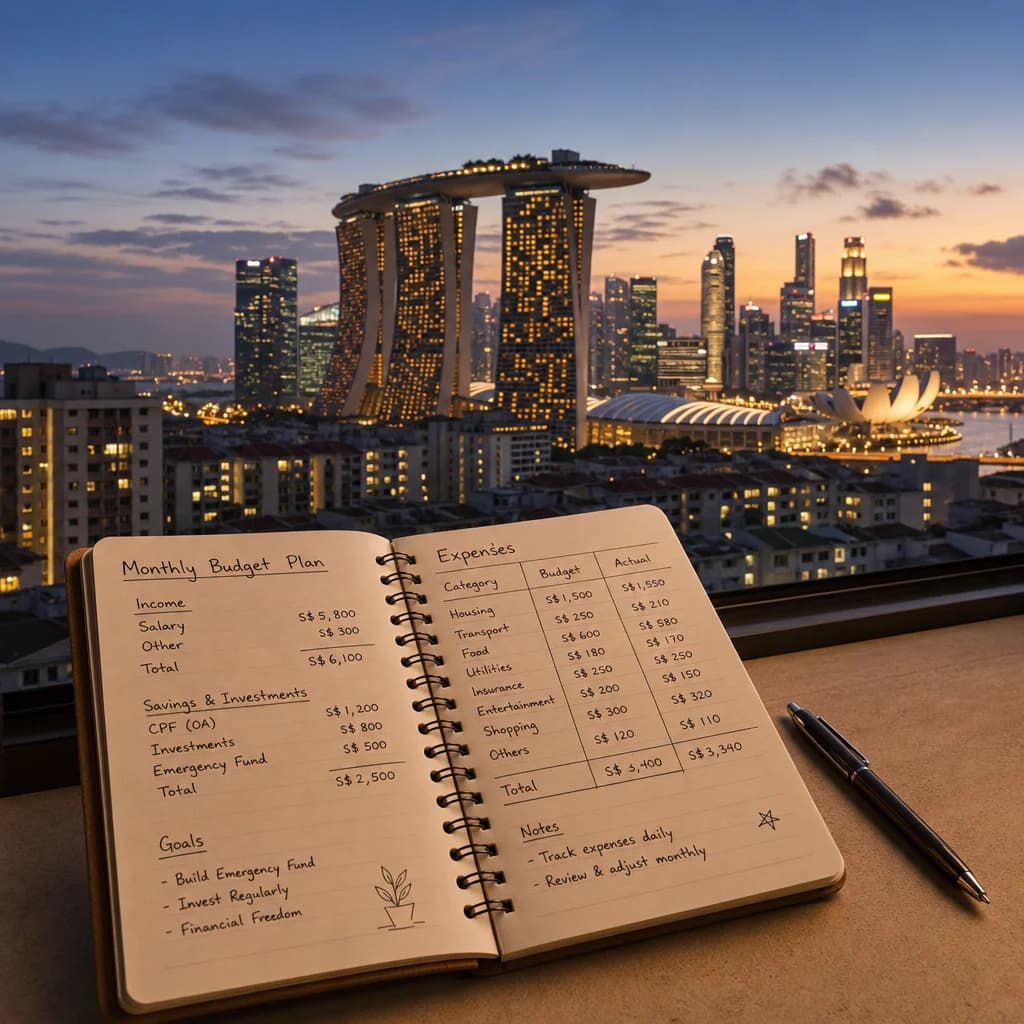
Executive Summary: Most Singaporeans in their 20s and 30s have never created a budget. Not because they cannot, but because no one ever showed them how. This guide changes that. Using nothing more than a phone, a free spreadsheet template, and about 20 minutes of honest review of your bank statements, you can build your first working budget in a single afternoon. No financial jargon, no complicated apps, no guilt — just a practical step-by-step system for knowing exactly where your money goes each month.
Why You Actually Need a Budget (And Why the Word Scares You)
The word "budget" sounds restrictive. It feels like a diet — something you go on when you have been bad. But a budget is not a restriction. It is a map. It tells you where your money actually goes, so you can decide intentionally instead of wondering at the end of the month where it all disappeared.
In Singapore, the cost of living is real. Rent takes a chunk. Hawker meals add up. Transport eats into your pay. And before you know it, the month is over and you have nothing saved. A budget does not solve that — but it gives you the visibility to make different choices before the month runs out.
If you have never tracked your spending before, start by just looking at your last 30 days of bank transactions. You do not need to change anything yet. Just observe. Most people are surprised by what they find.
Step 1: Find Your Starting Point — Track 30 Days of Spending
Before you can budget, you need to know where your money currently goes. This is not a judgment call — it is a fact-finding mission. Open your bank app, look at the last 30 days of transactions, and write down every amount you spent. Category them honestly:
- Fixed expenses — rent, utilities, insurance, phone plan, gym membership
- Transport — MRT, bus, Grab, petrol
- Food — groceries, hawker meals, coffee, restaurants
- Entertainment — streaming, games, outings
- Shopping — clothes, gadgets, online purchases
- Savings and investments — CPF, SRS, brokerage
- Miscellaneous — everything else
Do this for 30 days without changing anything. Just track. By the end of the month, you will have a real picture of your spending pattern — not an estimate, not a guess. This is your baseline.
Step 2: Set Your Income and Calculate Real Available Money
Write down your monthly take-home pay — after CPF contributions, after any deductions. This is the number you work with. Do not include bonuses or variable income until you can count on them consistently.
Then subtract your fixed expenses — the things that leave your account automatically every month before you can touch it. Rent, utilities, insurance, phone plan — these are non-negotiable costs that you cannot wish away. The remaining amount is your actually available money for the month.
Many people skip this step and budget from their full income, not realizing that $600 to $800 of their pay is already committed to fixed costs before they spend a single dollar on food or transport.
Step 3: Apply the 50/30/20 Rule to Your Singapore Reality
The 50/30/20 rule is a simple framework: 50% of your income goes to needs, 30% to wants, and 20% to savings and debt repayment. In Singapore, "needs" (50%) typically includes rent, utilities, transport to work, groceries, insurance, and minimum debt payments. "Wants" (30%) covers dining out, entertainment, subscriptions, hobbies, and lifestyle upgrades. "Savings" (20%) includes emergency fund contributions, CPF top-ups, investment contributions, and any extra debt repayment beyond minimums.
For a Singaporean earning $3,500 per month, the 20% savings portion is $700 — which compounds to $8,400 per year without any investment returns. For someone on $5,000 per month, it is $1,000 per month or $12,000 per year. This is not a small number. This is the difference between working until you are 65 and having the option to stop earlier.
The 50/30/20 split is a starting point, not a rigid rule. In Singapore, housing costs often make the 50% needs allocation unrealistic for lower-income earners. If your rent is $1,800 on a $3,500 income, you are already at 51% just on housing. Adjust the framework to fit your reality — the key is not the exact percentages, it is that you are intentional about the allocation.
Step 4: Create Your Monthly Spending Categories
Based on your 30-day tracking, create specific categories for your spending. Give each category a monthly limit that is realistic — not optimistic. If you spend $400 per month on food, do not budget $200 and hope for willpower. Budget $400 and find ways to reduce it gradually.
Use simple tools to track this: a spreadsheet, a notes app, or one of the free budgeting apps available in Singapore. The best tool is the one you will actually use every day. Do not overcomplicate this.
Step 5: Build Your Savings habit First
Before you spend on anything else, move your savings portion to a separate account the moment you get paid. Do not wait until the end of the month to see what is left — there will never be anything left. The money that goes to savings first is the money that actually saves.
For Singaporeans, the simplest first savings habit is setting up a standing instruction to move money to a high-yield savings account the day after payday. Even $100 per month is a start. The key is consistency, not amount.
Step 6: Review and Adjust Monthly
A budget is a living document, not a one-time exercise. At the end of each month, compare what you actually spent against what you planned. Adjust the categories for next month based on what you learn. If you went over on food, either budget more for food or explicitly decide to cut somewhere else. Every adjustment is data — it tells you something about your actual life versus your planned life.
Do not judge yourself for going over. Just adjust. The goal is accuracy over time, not perfection in any single month.
Common Budgeting Mistakes Singaporeans Make
- Budgeting gross income instead of net take-home pay
- Forgetting to include CPF contributions as a fixed deduction
- Underestimating hawker and coffee spending — $8 per meal adds up to $240 per month
- Not accounting for periodic expenses like insurance premiums, school fees, or family gifts
- Setting budgets so tight that there is no room for real life — then abandoning the budget entirely
- Tracking only what you remember instead of using actual bank transactions
Tools and Apps That Make Budgeting Easier in Singapore
You do not need a complicated system. The tools most Singaporeans use successfully include: the standard bank app's spending tracker (most banks offer this), a simple Google Sheets or Excel spreadsheet template, and the POSB/DBS budget tools if you bank with them. For those who prefer apps, Sparky and Money Matters are free options that work well for beginners.
The key feature you need is the ability to see your transactions categorized. Everything else is optional.
Your First Month Will Be the Hardest
The first month of budgeting is always the most uncomfortable. You are changing habits that have been running on autopilot for years. You will overspend in some categories. You will forget to track some expenses. You will feel frustrated. This is normal.
Do not quit because of a rough first month. The second month is easier. By the third month, you will start to see patterns and feel more in control. The goal is not to be perfect — it is to be aware. Awareness is what changes behavior over time.
What To Do With Your Savings Once You Have a Budget
Once you have a working budget and are consistently saving, the next step is making that savings work for you. The order of priority is: build a 3-month emergency fund first (keep it in a high-yield savings account like DBS Multiplier or OCBC 360), then max out your CPF contributions, then explore low-cost investment options like ETFs through a brokerage account if you have longer time horizons.
Do not jump to investing before you have an emergency fund. The return on having three months of expenses saved is not measured in interest — it is measured in the peace of mind that a job loss or medical emergency will not immediately destroy your financial stability.
Bottom Line
Budgeting is not a punishment. It is a clarity tool. The goal is to know where your money goes so you can decide, consciously and deliberately, how to allocate it — rather than watching it disappear every month with no plan.
Start today: open your bank app, look at the last 30 days of transactions, and write down every amount you spent. That is step one. Everything else in this guide builds on that foundation. No app, no course, no book required. Just your phone and five minutes of honesty.
Take control of your money today
Start free with Spendmate — track expenses, plan budgets, and reach your financial goals.
Start free with Spendmate