Let me tell you about my friend Razak. He earned $3,600 a month, lived in a HDB flat with his parents, and still ended 2024 with zero savings. Not because he was reckless, but because he never actually tracked where his money went. Every payday, the cash just evaporated. If that sounds familiar, you are not alone. Here is the thing most Singaporeans miss: your CPF contribution is technically part of your salary, which means the average fresh grad earning $3,500 per month is actually making closer to $5,395 before the government takes its share. This guide cuts through the noise with a Singapore-specific system that actually works.
Why Budgeting Feels Different in Singapore
Average starting salary for fresh grads in 2026 sits between $3,200 and $3,800. Median monthly household income hit $10,099 in 2025. Here is how that gets eaten away: Housing chews up 25-35% of your budget if you are renting or paying a mortgage. Transport runs 10-15%. Food takes another 10-15%. Healthcare, insurance, and entertainment each claim their slice. Oh, and GST went up to 9% in January 2024. Singapore inflation for 2025 came in at 2.9%, with 2026 forecast at 2.5-3.0%. In a high-cost, inflation-sensitive city like this, a written budget is not optional. It is survival.
Several things make Singapore budgeting unique. CPF mandatory savings pull 20% from your salary as an employee contribution, plus your employer chips in another 17%. HDB dominates as the housing path for most Singaporeans, which changes the math entirely. There is no welfare safety net equivalent to Western countries. Mobile payments through PayNow, FAST, and Nets are everywhere. And cultural factors like parental support norms, wedding costs, and face-related spending all affect your budget in ways generic Western advice simply ignores.
Step 1: Calculate Your Real Income After CPF
The first number on your pay slip is not the number you can spend. For someone earning $3,500 per month gross: CPF takes $700, leaving you with $2,800 before tax. After income tax of roughly $80-$150, your actual take-home pay lands around $2,650-$2,720. Budget from that number, not your gross salary. Everything else follows from here.
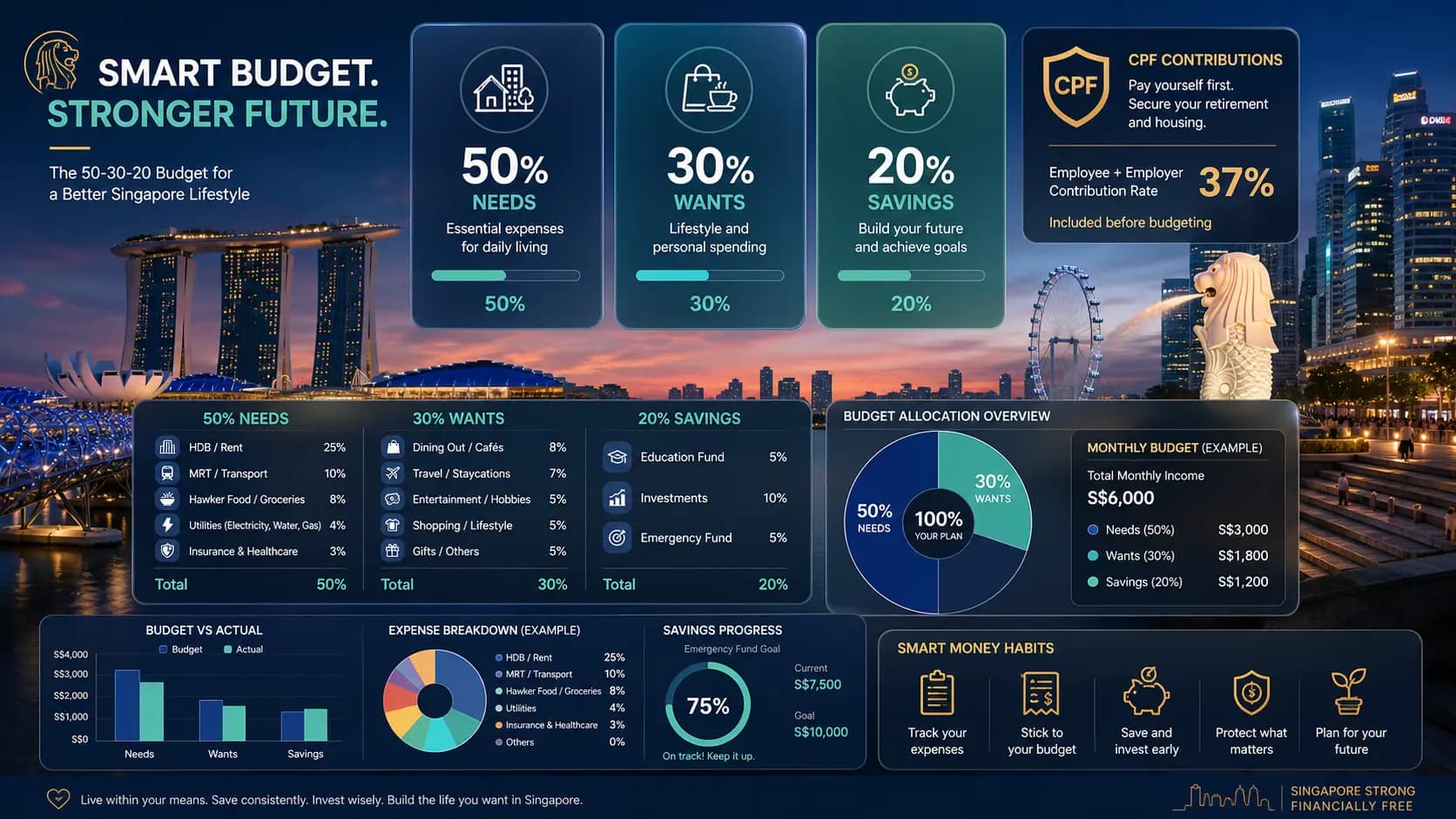
Here is how CPF breaks down for workers under 55 in 2026: you contribute 20% of your wages, your employer adds 17%, totaling 37% of your gross salary to CPF every month. That is not money you ever see in your bank account, but it is working for your future. The OA (Ordinary Account) funds housing and education. The SA (Special Account) stays locked until age 55. The MA (Medisave Account) covers medical expenses and hospitalization insurance. For daily budgeting, pretend CPF does not exist. It is not accessible until you need it.
Step 2: Track Your Actual Spending Before You Budget
You cannot budget what you do not know. Before creating a budget, track every dollar for 30 days. Singapore-specific tools worth trying: Sparkbook is popular with local budgeting communities, MoneySmart offers both tracking and planning features, and DBS MAX or POSB Digibank expense trackers are built into apps you probably already have. What matters is that you actually track consistently. Pick one and commit to it.
Here are the spending categories that matter for Singaporeans. Housing covers rent, room rental, HDB mortgage, utilities, and conservancy charges. Transport includes MRT/LRT, bus, taxi/Grab, COE if you own a car, petrol, ERP, and parking. Food means hawker centers, kopitiam, restaurants, groceries, and delivery. Healthcare covers clinic visits, dental, insurance premiums, and medication. Then there is insurance (life, health, critical illness), entertainment (Netflix, Spotify, movies, hobbies, travel), communication (mobile plan, internet, data), personal spending (clothing, haircuts, gifts, face expenses), savings and investments beyond CPF, and debt repayment.
Use these Singapore benchmarks as a percentage of take-home pay to check yourself: Transport should run 8-12% (panic if it hits 15% or more). Food should be 10-18% (worry if it goes past 20%). Entertainment at 5-10% is fine, but 15%+ means you are overspending. Healthcare at 3-5% is normal. Savings beyond CPF should hit 10-20% minimum. If you pay rent or mortgage from take-home pay, housing can consume 30-50% of what you bring home. In that case, the percentages above shift accordingly.
Step 3: Build Your Singapore Budget
The classic 50/30/20 rule (50% Needs, 30% Wants, 20% Savings) falls apart in Singapore. Needs regularly exceed 50% because housing is that expensive. Your CPF contribution is mandatory but never appears in your take-home pay. Tax gets auto-deducted before you see it. You need a Singapore-adapted framework.
Try this modified approach based on take-home pay instead. Essentials (Needs) take 50-60% and cover housing, transport, food, utilities, insurance, and minimum debt payments. Lifestyle (Wants) takes 15-25% and covers entertainment, dining out, hobbies, subscriptions, and personal purchases. Financial Future (Savings/Debt) takes 20-30% and covers your emergency fund, investments beyond CPF, and extra debt repayment. Adjust based on your actual situation, but hold the line on the savings percentage if you can.
Here is a sample budget for a fresh grad, single, renting a room, earning $3,500 gross per month. Gross Salary: $3,500. Less CPF (20%): -$700. Take-Home Pay: $2,800. Room Rental: $850. Transport: $120. Food (Hawker + Groceries): $450. Utilities + Internet: $80. Mobile Plan: $25. Health Insurance (starter IP): $150. Entertainment: $150. Personal: $100. Emergency Fund (HYSA): $400. Investments (ETFs): $300. Total savings including CPF: $700 (employee) + $700 (employer) = $1,400 per month, which is 40%. That is a strong start. The key is consistency. Set up standing instructions so savings happen on payday, not after you have already spent everything.
Step 4: The CPF Budget Integration
You do not see CPF leaving your pay, but it is going somewhere. Treat CPF contributions as a bill you pay to your future self. For someone earning $3,500 per month gross, your monthly CPF bill is $700 from you plus $595 from your employer, totaling $1,295 per month. That is significant forced savings. Do not ignore it in your overall financial picture, even though you cannot touch it for daily expenses.
How to use CPF strategically: Your OA can fund housing, whether that is an HDB mortgage or a resale flat. Your SA stays locked until 55, so do not count on it for any goals before that age. Your MA pays for MediShield Life and Integrated Shield Plans. One consideration: should you contribute extra to OA to fund housing sooner? Another: voluntary CPF contributions offer tax relief, but you lose liquidity. Weigh both carefully.
Step 5: Build Your Emergency Fund the Singapore Way
Job loss in Singapore can happen fast. Performance improvement plans and company restructuring are real risks here. Medical emergencies at private hospitals can cost $10,000 to $50,000. Family emergencies, including flights home and supporting parents, are culturally expected and expensive. COVID showed us how quickly everything can unravel.
How much do you need saved? Single, renting, no dependents: 3 months of take-home pay. Single, paying HDB mortgage: 6 months of take-home pay. Couple, dual income, no kids: 3 months of combined income. Couple, single income, kids: 6 months of that one income. High rent or high cost area: seriously consider 6 months regardless of your situation.
Where should you keep it? POSB or DBS savings accounts are liquid but earn low interest. Money Market Funds offer around 3.5% with decent liquidity. Singapore Savings Bonds exist, but each bond has a 1-month lock-in and you can only redeem one per month without penalty. Do NOT put emergency fund money in investments. Volatility defeats the purpose. Do NOT use fixed deposits. The penalty for early withdrawal eats your returns.
Step 6: Common Singapore Budgeting Mistakes
Mistake 1: Pretending CPF does not affect your budget. My salary is $3,500, right? No. Your take-home is $2,800. The $700 CPF contribution is real money leaving your pay. Always calculate from your actual take-home pay. Everything else is self-deception.
Mistake 2: Ignoring invisible expenses. Netflix, Disney+, Spotify, iCloud, Microsoft 365 all feel small individually but add up fast. Annual insurance premiums billed monthly are easy to forget until they hit. Impulse buys at hawker centers: you cannot find change so you just keep the $2. Retail therapy and treat-yourself culture are real budget killers. Running a subscription audit regularly is one of the fastest ways to cut $100 per month without changing your lifestyle at all.
Mistake 3: Comparing yourself to the wrong benchmark. Your colleague earning the same salary might have parents paying their phone bill, no rent because they live with family, no student loans because of a scholarship, or parents handling wedding costs. Compare yourself only to your own situation. Your financial journey is yours alone.
Mistake 4: Treating credit cards like free money. The interest-free period only works if you pay your full statement balance by the due date. Carry a balance and the effective interest rate on most cards runs 20-25% per year. That $1,000 holiday on your card becomes $1,250 if you take a year to pay it off. Use credit cards for convenience and rewards, not as a financing tool.
Step 7: Start Investing Beyond CPF
CPF returns approximately 2.5-4% depending on which account holds your money. That beats most savings accounts, but it will not build real wealth on its own. To reach financial independence, most calculators use 25 times your annual expenses as the target. You need additional investments beyond CPF to get there.
Good news: Singapore gives you access to some of the lowest-cost ETFs in the world through POSB and standard brokerage accounts. The standard recommendation for beginners is a low-cost global ETF like VWRA through IBKR or a local broker. In 2026, fractional share options from Syfe and Endowus let you start with as little as $10 per month. The key is starting. Time in the market beats timing the market. If you want a deeper comparison of debt payoff strategies, our guide on the debt snowball vs avalanche methods breaks down which approach works better depending on your psychology and debt structure.
Author Note
Budgeting in Singapore is harder than most Western countries because of CPF, HDB, and the general cost structure. But it is also more structured, which means the system works if you work the system. Start with tracking, move to budgeting, build your emergency fund, then invest. Skip steps and you will always feel behind. The order matters. If you are earning above median salary and still feeling broke, the problem is almost always visibility, not income.
FAQ: Budgeting for Beginners Singapore
- What is the 50/30/20 rule and does it work in Singapore?
- The 50/30/20 rule divides take-home pay into 50% needs, 30% wants, and 20% savings. It does not translate well to Singapore because housing often exceeds 50% of take-home on its own, and CPF contributions are mandatory but never appear in your take-home pay. Use the modified framework instead: 50-60% Essentials, 15-25% Lifestyle, 20-30% Financial Future. Adjust based on your actual rent situation.
- How much should a fresh grad save in Singapore?
- Aim for at least 20% of take-home pay in savings beyond CPF contributions. If you earn $3,500 gross ($2,800 take-home), that means $560 per month minimum. If you can push to 30-40% when you include your CPF contributions, even better. Where you start matters less than whether you start. A common mistake is waiting until you earn more to save, but the habits you build now matter more than the amount.
- Is CPF actually worth it for young Singaporeans?
- Yes, CPF is worth it. Your OA earns roughly 2.5%, SA earns 4%, and MA earns 4%, which all beat standard savings account rates. The real value is the employer contribution: they add 17% on top of your 20% contribution. That is free money going into your future, locked until you need it or until you hit 55. The only downside is liquidity, which is why you build separate emergency savings outside CPF.
- How do I start investing as a beginner in Singapore?
- Open a brokerage account first. IBKR, Syfe, and Endowus are popular choices for beginners in Singapore. Start with a global ETF like VWRA that gives you worldwide diversification. Invest monthly using dollar-cost averaging, even if it is just $100 per month to start. In 2026, fractional share options from Syfe and Endowus make it possible to start with very small amounts. The biggest mistake beginners make is waiting for the perfect time to start. There is no perfect time.
- What is a good emergency fund for Singaporeans?
- Single, renting, no dependents: 3 months of take-home pay. If you have housing costs or dependents, go for 6 months of take-home pay. Keep your emergency fund in a liquid account like POSB or a money market fund. The returns are secondary to accessibility. Do not put emergency fund money into investments or locked-in instruments. If you cannot access it within 24 hours without penalty, it is not an emergency fund.
- How do I budget if I live with my parents in Singapore?
- You are in a privileged position financially, even if it does not feel like it. Your cost structure is significantly lower than someone renting. Contribute fairly to household expenses even if your parents do not ask, build your emergency fund aggressively, and start investing early. Because your cost structure is lower, your savings rate should be 40-50% minimum. Use the money you save on housing to build wealth fast instead of upgrading your lifestyle.
- Should I use the SSB (Singapore Savings Bond) for emergency funds?
- No. SSBs have a 1-month lock-in per bond and you can only redeem one bond per month without penalty. For emergency funds, liquidity matters more than yield. If you lose your job and need cash fast, you cannot break an SSB quickly. Use a high-yield savings account or money market fund instead. SSBs are great for goals 1-3 years out, not for emergencies.
- How do I track expenses in Singapore effectively?
- Use the POSB Digibank or DBS MAX app expense tracker if you bank locally. Both are free and automatically categorize your spending. If you want a dedicated budgeting experience, Sparkbook is built specifically for Singapore users. The best app is the one you will actually open every day. If you prefer paper, a simple notebook works just as well. What matters is consistency, not the tool.
- What is the average cost of living in Singapore for a single person?
- For a single person renting a room in a shared HDB flat, expect to spend $1,500-$2,200 per month total. Room rental typically runs $700-$1,000, food costs $400-$600, transport $80-$150, utilities $50-$80, and miscellaneous spending $200-$400. These are ranges to expect, not fixed amounts. Your actual number depends on your lifestyle, location, and whether you cook at home or eat out constantly.
- How do I reduce expenses without sacrificing quality of life in Singapore?
- Cook at hawker centers more than restaurants. Use public transport instead of Grab unless you genuinely need to. Cancel subscriptions you have forgotten about. Shop at NTUC FairPrice and Sheng Siong instead of premium supermarkets. Buy groceries in bulk at Costco or Giant when it makes sense. These changes alone can save $300-$500 per month without fundamentally changing how you live. Most people find they do not miss what they cut once they get used to it.
Take control of your money today
Start free with Spendmate — track expenses, plan budgets, and reach your financial goals.
Start free with Spendmate