
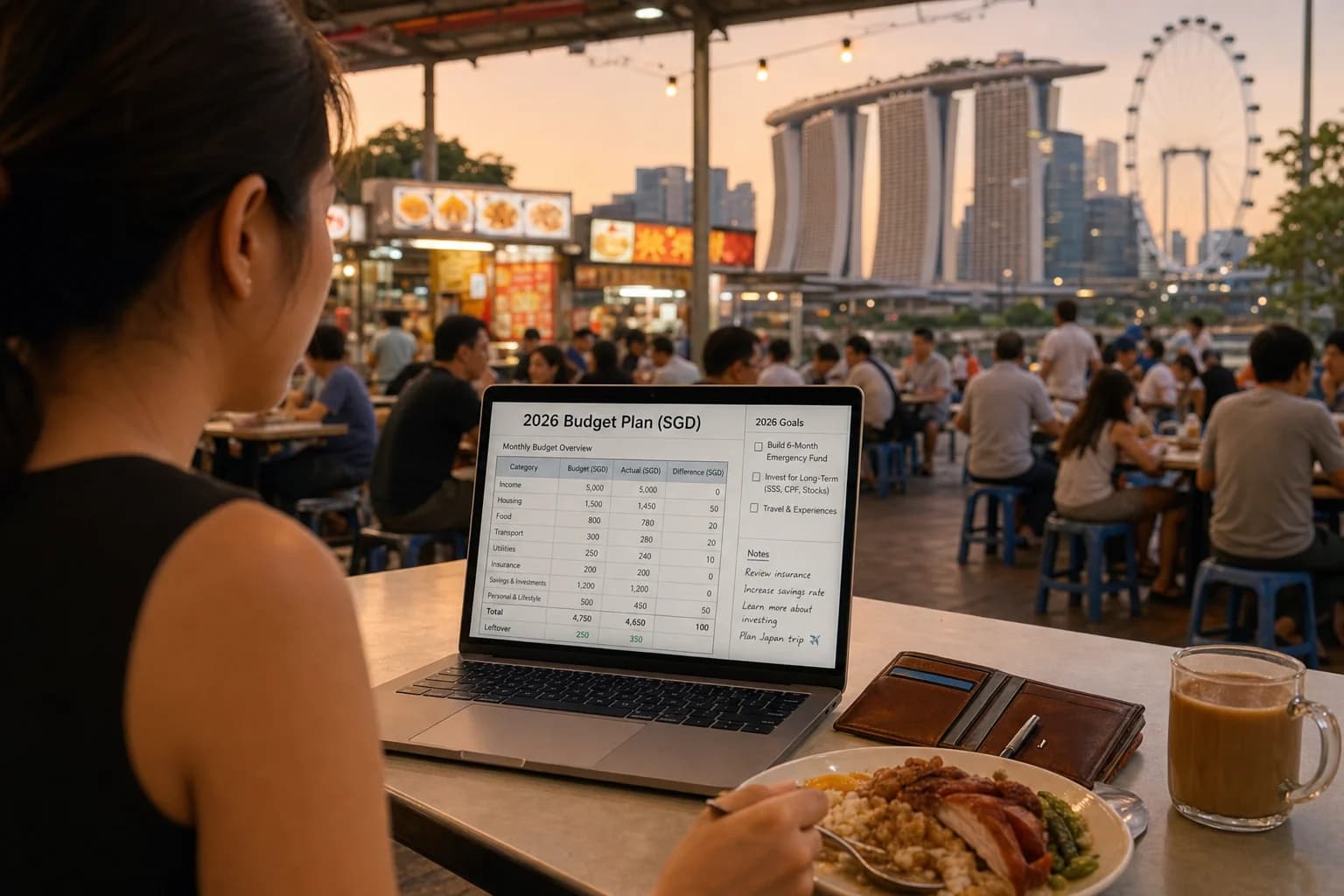
You got your first paycheck. Congrats. Now what? Most young Singaporeans were not taught how to manage money in school — and that gap costs thousands. Here is exactly how to budget as a beginner in Singapore, with a system designed for Singapore income, CPF contributions, and local expenses.
Budgeting for Beginners in Singapore: A Step-by-Step Guide to Take Control of Your Money (2026)
Before diving into specific tactics, here is the direct answer: budgeting in Singapore starts with knowing your take-home pay, tracking where every dollar goes for one month, and then assigning every dollar a job before the month begins. The system below walks you through that process step by step.
Why Budgeting Matters More in Singapore Than Anywhere Else
Singapore has one of the highest costs of living in Asia. According to the Department of Statistics Singapore, the median monthly household income is SGD $10,099. For a fresh graduate earning $3,000–$3,500/month net, after CPF deductions of approximately 20%, the take-home pay feels surprisingly small — and that is before rent, transport, and hawker food add up.
The CPF system changes the financial picture fundamentally. Your employer contributes 17% of your wage (for ages under 55) into your CPF account. On a $3,500 gross salary, that is an extra $595/month that most entry-level earners never factor into their financial thinking. CPF is not a tax — it is forced savings earning 2.5% interest per annum in your Ordinary Account, tax-free.
Without a budget, the combination of local social costs (hangouts at Jewel, group dinners, Grab rides) and everyday expenses silently drains your account before the month ends. Most young Singaporeans who end up living paycheck to paycheck are not overspending on luxuries — they are leaking money through small, untracked daily purchases that add up to hundreds of dollars per month. For a broader perspective on why budgets fail, see our guide on why budgets fail.
Understanding Your Singapore Income: What Is Actually in Your Bank Account?
Gross vs Net Salary in Singapore
Your payslip contains more than your take-home pay. Understanding every line item is the foundation of budgeting correctly. For a Singaporean employee on the CPF scheme, the standard deductions are: employee CPF contribution at 20% of wages up to the wage ceiling of $6,800/month, and the Skills Development Levy (SDL) at 0.25% of wages (capped at $2.17/month). Your employer additionally contributes 17% up to the wage ceiling.
Here is what a $3,500 gross salary actually means: Basic monthly wage of $3,500 minus employee CPF contribution of $700 (20%) minus SDL of $2.17 — your approximate take-home is $2,798. Your employer adds $595 to your CPF. You do not see the $595, but it is yours.
Take-Home Pay by Gross Salary Level
- $2,500 gross: roughly $2,000 take-home (+ $425 employer CPF)
- $3,000 gross: roughly $2,400 take-home (+ $510 employer CPF)
- $3,500 gross: roughly $2,798 take-home (+ $595 employer CPF)
- $4,000 gross: roughly $3,200 take-home (+ $680 employer CPF)
- $5,000 gross: roughly $4,000 take-home (+ $850 employer CPF)
- $7,000 gross: roughly $5,600 take-home (+ $1,190 employer CPF, partial wage ceiling applies)
The Singapore Budgeting Framework: 50/20/30 Adapted
The US 50/30/20 rule (50% needs, 30% wants, 20% savings) does not translate directly to Singapore because of CPF. The employer contribution is already 17% of your gross — it is forced savings you do not control. A more accurate Singapore framework is: 50% for essential needs, 20% for CPF (your mandatory savings on top of employer contributions), and 30% for goals and discretionary spending. To understand how this compares to global standards, read our breakdown of whether the 50/30/20 rule works in Singapore.
The 50% — Needs (Essential Monthly Expenses)
- HDB rental or mortgage / parents allowance: $300–$1,200/month depending on situation
- Utilities and service conservancy charges (S&CC): $80–$180/month
- Public transport (Ez-Link / SimplyGo): $80–$150/month
- Mobile plan and internet: $40–$80/month
- Groceries (wet markets, NTUC, FairPrice): $150–$300/month
- Hawker food budget: $300–$450/month (be honest with yourself here)
- Health insurance (MediShield Life + private if applicable): $50–$150/month
For a single person living with parents and commuting daily, essential needs typically total $800–$1,200/month. This is your 50% anchor.
The 20% — CPF (Your Forced Savings)
Your CPF OA earns 2.5% interest per annum — guaranteed, tax-free, and outperforming most savings accounts in 2026. Do not think of CPF as something that happens to you. Think of it as your most reliable investment. Your OA is also the vehicle for your first HDB flat down payment, which most Singaporeans tap between ages 25 and 35. The SA (Special Account) earns up to 4% interest and is your retirement nest egg. View CPF as 20% of your take-home pay being diverted to a locked, high-yield savings account you cannot touch until 55.
The 30% — Goals and Growth (Discretionary + Savings)
- Emergency fund transfer: 10–15% of net income (priority #1 until you have 3–6 months of expenses covered)
- Savings for big goals (holiday, gadget, wedding, car): 5–10%
- Investment start (endowment plan, ETF, SRS for higher earners): 5–10%
- Self-improvement (courses, certifications): 2–5%
If you earn $3,000 net, your 30% is $900. From that, your first priority is building an emergency fund of $6,000–$12,000 (3–6 months of $2,000–$2,500 monthly expenses). At $300/month minimum transfer, you can reach $6,000 in 20 months.
Step 1: Calculate Your Take-Home Pay
Before anything else, you need an honest number. Use the CPF contribution calculator on cpf.gov.sg to compute your exact take-home from your gross salary. Then add all income sources: base salary, allowances, overtime, freelance income. Average your last three months if income varies. Write that number down. This is the figure you will budget against — not your gross salary.
Action: Calculate your last three months average net income right now. That is your budget baseline.
Step 2: Track Your Spending for One Month
The Singapore Expense Categories to Track
- Fixed expenses: Rent/mortgage, utilities, insurance, phone, internet, transport card top-ups
- Variable expenses: Groceries, hawker food, Grab rides, entertainment, shopping
- Occasional expenses: Gifts, travel, medical checkups, subscriptions
How to Track Without an App (Beginner Methods)
Option A: A simple notebook and pen — old school and effective for the first month. Option B: Your bank app transaction history — most local banks (DBS, OCBC, UOB) auto-categorize spending and show weekly/monthly summaries. Option C: A Google Sheets or Excel template with categories pre-set. Option D: Singapore-specific apps like AutoSave, PocketMoney, or Splitwise for shared expenses.
Tip: Review every Sunday for 15 minutes. It takes 4 weeks to form the habit. You do not need an app — you need consistency.
Step 3: Build Your First Budget
The goal of your first budget is not optimization — it is awareness. Most beginners discover that their hawker food spending is $100–$150 higher than they thought, or that their Grab rides add up to $200/month. The budget reveals the leaks.
The Beginner Budget Template (Singapore-Specific)
Monthly Income (Net): SGD $_____
- CPF Contribution: Already auto-deducted (do not double-count)
- Housing / Parents Allowance: SGD $_____
- Utilities + S&CC: SGD $_____ (roughly $120–$180)
- Transport (Ez-Link / SimplyGo): SGD $_____ (roughly $100–$150)
- Mobile + Internet: SGD $_____ (roughly $50–$80)
- Groceries: SGD $_____ (roughly $200–$350)
- Food (Hawker / Restaurants): SGD $_____ (roughly $300–$450 — be honest)
- Healthcare / Insurance: SGD $_____ (roughly $50–$150)
- Emergency Fund Transfer: SGD $_____ (10–20% of net income)
- Goals Savings: SGD $_____ (5–10% of net income)
- Discretionary Buffer: SGD $_____ (whatever remains)
The Zero-Based Budget Concept
Zero-based budgeting means every dollar has a job before the month starts. Spare money goes to your emergency fund or a specific goal — not to random spending. If you finish the month and discover you spent less on hawker food than budgeted, carry that surplus to the next category intentionally. Even $50 extra to your emergency fund accelerates your timeline.
Step 4: Automate Your Savings (Pay Yourself First)
Automation is what separates people who consistently save from people who intend to save. Set up an auto-transfer from your salary account to a dedicated savings account on pay day — ideally the day after you get paid, before you have a chance to spend it.
- Link a separate savings account to your salary account for your emergency fund. DBS Multiplier, OCBC 360, and UOB One all offer competitive interest rates on your first $20,000–$60,000.
- For higher earners ($7,000+/month): consider automating contributions to your SRS account for tax relief.
- For investment-ready savings: some use endowments or ETF regular savings plans (RSPs) through brokerage accounts. Only do this after your emergency fund is fully funded.
The $500/Month Beginner Savings Plan: If you earn $3,000 net, saving $300–$500/month is realistic and aggressive. In year one, that is $3,600–$6,000 added to your emergency fund. By year two with interest compounding at 2.5%, you are building real financial momentum.
Step 5: Build Your Emergency Fund
Singapore has no universal healthcare subsidy for non-subsidized treatment. Job loss, medical emergencies, and family emergencies are real risks that can derail a new budgeter quickly. Your emergency fund is your financial buffer — not an investment. To learn how much you actually need, read our complete guide on how much emergency fund you need.
Why Singaporeans Need a Separate Emergency Fund
CPF is locked until 55. Do not count OA funds as liquid savings. If you lose your job or face a medical emergency, you need cash you can access immediately. A $1,000 emergency fund will not cover even one month of expenses for most Singaporeans.
- Recommended: 3 months minimum, 6 months ideal
- $1,500/month expenses: target $4,500–$9,000 emergency fund
- $2,000/month expenses: target $6,000–$12,000 emergency fund
- $2,500/month expenses: target $7,500–$15,000 emergency fund
Where to Keep Your Emergency Fund
High-interest savings accounts are ideal: DBS Multiplier (up to 3.5% p.a. with salary credit + investment), OCBC 360 (up to 2.85% p.a. with conditions), or UOB One (up to 4.05% p.a. for first $30,000). Avoid: joint accounts (someone else can withdraw), fixed deposits with early withdrawal penalties, and investment accounts.
Step 6: Review and Adjust Every Month
The monthly 15-minute review is your accountability system. Every Sunday evening, open your banking app and compare actual spending against your budget. Which category was overspent? Hawker food temptation is real and common. What was underspent? Carry those savings forward intentionally rather than letting them disappear.
Budget Changes as You Earn More
- Fresh graduate ($2,500–$3,500 net): focus on emergency fund + building the tracking habit
- Junior executive ($3,500–$5,000 net): increase emergency fund to 6 months, start investing 5–10%
- Mid-level ($5,000–$8,000 net): optimize CPF OA contributions, consider SRS for tax relief, plan HDB
- Senior ($8,000+ net): tax optimization, investment diversification, building wealth beyond CPF
Common Beginner Mistakes in Singapore
- Ignoring CPF as part of budget: "It is automatic, so I do not count it" — include it in your mental model. It is 17% employer contribution you earned.
- Budgeting gross salary: Always budget net (take-home pay). Gross salary minus CPF minus SDL minus income tax is what you actually receive.
- No emergency fund: Job loss can happen. CPF OA is not accessible until 55. You need 3–6 months of expenses in a liquid savings account.
- Lifestyle inflation when salary rises: First big raise = new phone. Automate your savings increase before lifestyle upgrades.
- Overestimating Hawker food savings: $5 breakfast + $6 lunch + $5 dinner = $480/month quickly. Hawker is affordable but not free.
- Not tracking small purchases: "It is only $3." Small leaks sink budgets. Track everything, even the $2 Teh C.
FAQ — Budgeting for Beginners Singapore
How much should a fresh graduate save in Singapore?
Aim for 10–20% of your take-home pay. On a $3,000 net salary, that is $300–$600/month. Start with whatever you can — $100 is better than $0. Prioritize building your emergency fund first before aggressive investing.
What is the average monthly expenses for a single person in Singapore?
$1,800–$2,500/month for essentials (housing, food, transport, utilities) depending on whether you live with parents, rent a room, or have your own HDB. Excluding rent with parents, you can get by on $800–$1,200/month for essentials.
Should I include CPF in my budget?
Yes. Although CPF is automatic, include it in your financial awareness. You earn 2.5% on OA and up to 4% on SA — that is real wealth building. View CPF as 20% mandatory savings on top of your take-home pay. The employer 17% contribution is hidden income you have earned.
How do I budget if I live with my parents?
Count a "family allowance" as an expense even if it is reduced or waived. Budget the same way you would if you were paying full rent. Many young Singaporeans waste this advantage by not building savings habits while living cheaply at home — and then struggle when they eventually move out.
Is $1,000 enough for an emergency fund in Singapore?
No. A $1,000 emergency fund will not cover even one month of expenses for most Singaporeans. Target 3–6 months of your actual monthly expenses. For someone spending $2,000/month, that is $6,000–$12,000 minimum. Start building it immediately and keep it in a separate high-interest savings account.
How do I start investing if I am living paycheck to paycheck?
Fix the paycheck-to-paycheck problem first. Build your emergency fund to $5,000–$10,000 before investing any money. Once you have $5,000+ liquid, you can start a regular savings plan (endowment or ETF). Do not invest before you have an emergency fund — market downturns + job loss = financial disaster.
What is the best budgeting app for Singaporeans?
AutoSave (for spending tracking and insights), DBS PayLah! (for payment overview), Splitwise (for shared expenses with roommates or partners), and any bank own tracker. The best app is the one you will actually use every day. Do not overthink the tool — start with your bank app.
How do I budget for irregular income (freelance, commission-based)?
Budget based on your lowest month, not your highest. Set aside 30–40% of good months for taxes and lean months. Build a 6-month emergency fund if your income is volatile. Assign every dollar a job on the day you receive payment.
Should I prioritize CPF or emergency fund?
Emergency fund first. CPF OA earns 2.5% but is locked until 55 and meant for housing and retirement. An emergency fund in a savings account is liquid — you need it for actual emergencies now. Once you have 3–6 months covered, then optimize CPF contributions where possible.
How do I stop overspending on hawker food and transport?
Track every transaction for 2 weeks and you will see where small charges add up. Set a weekly hawker budget ($80–$100/week) and a transport top-up limit ($80–$120/month). Use SimplyGo to monitor your balance and set alerts when you are near your limit. Awareness alone is usually enough to change behavior.
This article is for informational purposes only and does not constitute financial advice. Please consult a licensed financial adviser for personalized guidance. CPF rules and contribution rates are subject to change by the Singapore Government.
Take control of your money today
Start free with Spendmate — track expenses, plan budgets, and reach your financial goals.
Start free with Spendmate