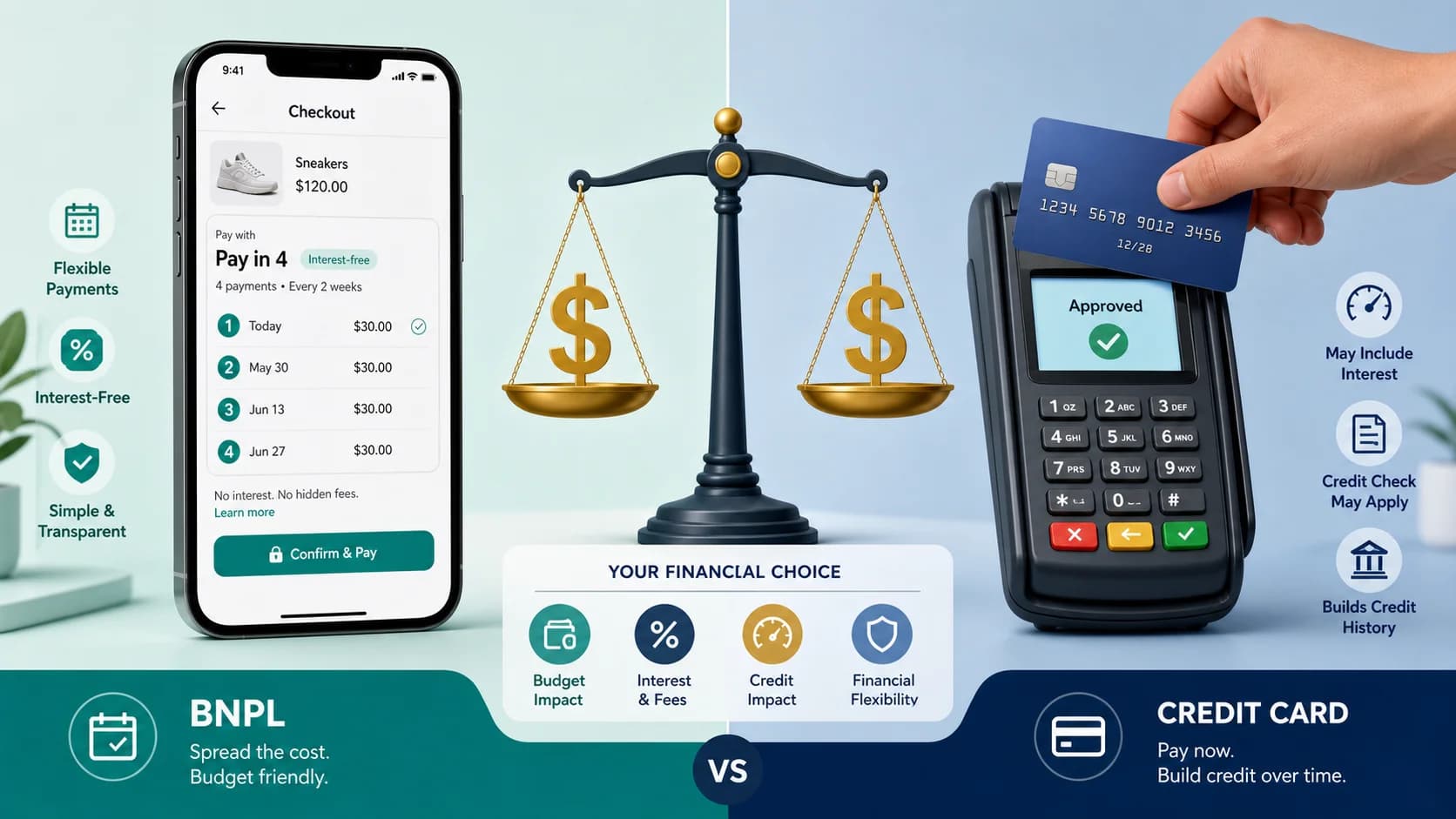
You are about to buy something. The total is $800. At checkout, you see two options: Pay in 4 interest-free installments with BNPL, or put it on your credit card. Which one actually saves you money? The answer is not as simple as "BNPL has no interest." Let us do the math together. This guide breaks down real costs, credit score impacts, and smart use cases for both payment methods — so you can choose the right tool for YOUR situation, not a one-size-fits-all rule.
The Short Answer — It Depends on Your Situation
Both BNPL and credit cards have their place in a modern financial toolkit. The right choice depends entirely on your specific situation: whether you can pay in full, how large the purchase is, whether you have a rewards card, and how the purchase affects your credit. Neither is universally better. Both can be used responsibly or destructively. The goal is matching the tool to the task.
If you want the quick verdict: use a credit card when you can pay in full and earn rewards. Use BNPL when you need a short-term payment plan and do not have a rewards card. Avoid both when you are already struggling with debt.
What Is BNPL and How Does It Actually Work?
Buy Now, Pay Later (BNPL) is a payment structure that splits a purchase into several smaller installments, typically four interest-free payments spread over six weeks. The first payment is made at checkout, and the remaining three are auto-debited every two weeks. Major providers include Affirm, Klarna, Afterpay, and PayPal Pay in 4.
BNPL providers make money primarily through merchant fees — merchants pay 2–8% of each transaction to BNPL companies. Some providers also charge interest on longer-term plans (6–24 months) ranging from 10–30% APR, and late fees of $5–$10 per missed installment, capped in many states by regulation.
What BNPL providers often do not make clear upfront: multiple active BNPL plans mean multiple auto-debit obligations hitting the same day, potentially straining your cash flow. Not all BNPL services report to credit bureaus — some only report delinquencies, while others report on-time payments to help you build credit. For larger Affirm loans, a hard credit pull may be involved, which can temporarily lower your credit score by 5–10 points.
What Is a Credit Card and How Does It Actually Work?
A credit card is a revolving line of credit that allows you to borrow money up to a set limit for purchases, balance transfers, or cash advances. You are required to make a minimum payment each month, but carrying a balance beyond the statement due date triggers interest charges at the card's APR — averaging 21–24% in 2026.
Credit cards earn money through interest on carried balances, late fees ($30–$40 per missed payment), annual fees on premium cards ($95–$550/year), and interchange fees paid by merchants. However, credit cards also offer benefits that BNPL does not: purchase protection and warranty extension, travel insurance and rental car coverage, rewards and cash back (1–5% on most purchases), fraud liability protection ($0 in most cases), and a proven path to building credit through consistent on-time payments.
The key advantage of credit cards is the grace period — if you pay your full balance by the statement due date, you pay zero interest on purchases. This is the single most important feature that makes credit cards superior to BNPL when you can pay in full.
Head-to-Head Comparison — Real Cost Scenarios
Here is where the nuance matters. Generic "BNPL has no interest" claims fall apart when you look at real dollar amounts. These five scenarios show exactly how each payment method performs across different purchase sizes and payoff timelines.
- Interest: BNPL 4-pay = 0% if on time; credit cards = 21–24% APR (Federal Reserve 2024 consumer credit report)
- Late fees: BNPL = $5–$10 per missed installment; credit cards = $30–$40 per missed payment (CFPB)
- Credit impact: BNPL = inconsistent, mostly soft pull; credit cards = hard pull on application, 35% payment history weight (FICO)
- Fraud protection: BNPL = limited, varies by provider; credit cards = $0 liability, strong dispute rights
- Rewards: BNPL = none typically; credit cards = 1–5% cash back on purchases
- Purchase protection: BNPL = weak; credit cards = strong, card network rules apply
Scenario 1 — $500 Purchase, Paid Off in 6 Weeks
BNPL (4-pay plan, paid on time): $0 interest, $0 fees = $500 total. Credit Card (paid in full before statement due date): $0 interest = $500 total. Result: A tie. Both methods cost the same when you pay on time and in full. The deciding factor in this scenario is whether your credit card earns rewards — if it does, the credit card wins by the cash back earned.
Scenario 2 — $1,000 Purchase, Paid Over 3 Months
BNPL (4-pay plan, 0% interest): $0 interest, $0 fees = $1,000 total. Credit Card (carrying balance at 22% APR (Federal Reserve 2024 consumer credit report) (per Federal Reserve 2024 consumer credit report), per Federal Reserve's 2024 consumer credit report): approximately $37 in interest = $1,037 total. Result: BNPL saves $37. If you cannot pay in full within the first billing cycle, BNPL's interest-free structure is cheaper than carrying a credit card balance.
Scenario 3 — $2,000 Purchase, Paid Over 6 Months
BNPL (6-month plan at 15% APR, typical for longer installment plans): approximately $78 in interest = $2,078 total. Credit Card (22% APR, per Federal Reserve data, per Federal Reserve data, per current Federal Reserve data): approximately $132 in interest = $2,132 total. Result: BNPL saves $54. Longer-term BNPL plans can be cheaper than credit cards for medium-sized purchases — but only if the BNPL plan has a lower APR than your credit card. Always check the rate before committing.
Scenario 4 — $800 Purchase, Miss One Payment
BNPL (missed installment): $10 late fee plus possible account suspension and accelerated remaining balance = $810+ total. Credit Card (missed payment): $40 late fee (per CFPB fee study) (per CFPB fee study) (per CFPB fee study) plus potential penalty APR trigger (up to 29.99% applied retroactively) = $840+ total. Result: BNPL has a lower penalty for a single miss. However, BNPL account suspension can be severe — your entire remaining balance may become due immediately, which can create a cash flow crisis.
Scenario 5 — $1,500 Purchase With a 3% Cash Back Card
BNPL (4-pay plan, paid on time): $0 interest = $1,500 total, $0 in rewards. Credit Card (paid in full): $0 interest, -$45 cash back earned = $1,455 net cost. Result: The credit card wins by $45. This is the scenario where rewards cards change the math entirely — if you can pay in full, a cash back or rewards credit card effectively discounts every purchase.
Credit Score Impact — BNPL vs Credit Cards
How does each payment method affect your credit score? The short answer: credit cards have a proven, well-established impact on credit scores. BNPL's credit impact is inconsistent and provider-dependent.
Most BNPL services perform a soft pull when you apply — no impact to your score. Some larger Affirm loans involve a hard pull, which can temporarily drop your score by 5–10 points. BNPL payment reporting varies widely: some providers report on-time payments to credit bureaus (helping your credit), some only report late payments, and some do not report at all. Multiple active BNPL plans appear as multiple obligations when lenders review your credit report.
Credit cards affect your credit score through several mechanisms. The initial application triggers a hard pull (5–10 point temporary drop). Credit utilization — per FICO scoring guidelines, how much of your available credit you are using — has a significant impact (keep utilization under 30%, ideally under 10%). On-time payments account for 35% of your FICO score, the largest single factor. The length of your credit history matters — keeping older cards open helps. Responsible, consistent credit card use over 12–24 months can meaningfully improve your credit score.
If building credit is your goal, credit cards win decisively. The reporting is consistent, the utilization metrics are well-understood by lenders, and on-time payments are reliably recorded. BNPL is neutral to uncertain for credit building — the reporting is too inconsistent to rely on.
When to Use BNPL — Smart Use Cases
BNPL is the right choice in these specific situations: you have the money but want to preserve cash flow temporarily, the purchase is in the $200–$1,000 sweet spot for 4-pay plans, you are certain you can make all four payments on time, you do not have a rewards credit card, you want to avoid a credit card utilization spike before applying for a major loan, or the purchase is time-sensitive (sale ending, limited stock).
- Back-to-school shopping: $400 total, split across 4 weeks
- Car repair needed immediately: $600, next paycheck in 2 weeks
- Holiday gifts in December: $800, January paycheck covers it
- Furniture purchase: $900, moving next month, cash flow temporarily tight
The discipline required for BNPL is straightforward: only use it when you are confident the money is coming within the payment schedule, never stack multiple BNPL plans beyond what your budget can handle, and treat the payment schedule as a commitment, not a suggestion.
When to Use a Credit Card — Smart Use Cases
A credit card is the better choice when: you can pay the full balance before the statement due date, you have a rewards or cash back card earning 2–5% on purchases, the purchase needs fraud protection or extended warranty coverage, you are traveling (credit cards offer superior dispute resolution and insurance), you want to build or improve your credit score, or the purchase is large ($1,000+) and you want purchase protection.
- Electronics purchase: $1,200 laptop, paid in full, 3% cash back = $36 earned
- Flight booking: $800, travel insurance included, airline points earned
- Online shopping: fraud protection, easy dispute if item never arrives
- Building credit: small recurring charges, autopay in full monthly
For tracking your expenses and managing these payment obligations, a simple expense tracking system helps you stay on top of what is due and when. Understanding your spending patterns also helps you recognize whether you are reaching for BNPL or credit out of habit or genuine need.
When to Use NEITHER — Cash, Debit, or Wait
Avoid both BNPL and credit cards when: you are already struggling with existing debt (neither solves the root problem), the purchase is discretionary and you do not have the cash on hand, you have a history of missing payments (fees will compound quickly), you are using BNPL on multiple purchases simultaneously (payment pile-up risk is real), or the item is a want disguised as a need and you are buying it to cope with stress.
Better alternatives include the wait-and-save approach — delay the purchase 30 days and reassess whether you still want it. Buy used or refurbished to lower the upfront cost. Negotiate a payment plan directly with the merchant (some furniture and appliance stores offer this without third-party fees). Use a debit card to spend only money you actually have. Or sell something you own to fund the purchase without borrowing.
The Hidden Risks — What No One Tells You
BNPL carries specific risks that are easy to overlook at checkout. Payment stacking occurs when 5 BNPL purchases all auto-debit on the same day — this is one of the most common ways people end up in financial trouble with BNPL. The psychological effect of "only $25 today!" makes purchases feel cheaper than they are, which triggers overspending. Missing one payment can trigger account suspension, which accelerates your entire remaining balance to be due immediately. BNPL has limited dispute resolution compared to credit cards — contesting a faulty product is harder. Additionally, not all purchases qualify for BNPL — some merchant categories are excluded.
Credit card risks are well-documented but still catch people. Interest compounding means carrying a balance causes interest to accrue on interest, making the true cost of purchases much higher over time. A single late payment can trigger a penalty APR of up to 29.99%, which may apply retroactively to existing balances. High credit utilization — maxing out cards — tanks your credit score quickly. The minimum payment trap is real: paying only the minimum on a $2,000 balance at 22% APR extends your debt for over 7 years and costs thousands in interest. Annual fees on premium cards must be offset by benefits or they become pure cost.
Decision Framework — Choose Your Payment Method
Use this decision tree to determine which payment method fits your situation. Start at the top and work down.
Step 1: Can you pay the full purchase amount this month? If YES → Use a credit card and pay in full to earn rewards and build credit. If NO → Continue to Step 2.
Step 2: Is this purchase a need or a want? If it is a want and not urgent → Wait 30 days or save up first. If it is a need → Continue to Step 3.
Step 3: Will you have the full amount within 6 weeks? If YES → BNPL 4-pay plan is appropriate (0% interest, manageable timeline). If NO → Continue to Step 4.
Step 4: Is this purchase $1,000+ requiring 6+ months to pay? If YES → Compare BNPL 6–12 month plan APR against a personal loan APR. A personal loan may be cheaper. If NO → Reconsider the purchase or explore ways to increase your income first.
Red flags that mean "do not buy right now": you are using BNPL to pay for previous BNPL purchases, you have missed any payment in the last 90 days, you do not know when you will have the money (vague timeline), you feel anxious about the purchase but are doing it anyway, or you are hiding the purchase from your partner or family.
FAQ — BNPL vs Credit Cards
About the Author: This comparison draws on Federal Reserve consumer credit data, CFPB fee research, and FICO scoring guidelines to cut through marketing language and give you the actual numbers behind each payment method.
One contrarian observation worth considering: BNPL's simplicity can be a psychological trap even for financially literate people. A 22% APR feels abstract. Four payments of $267 feel concrete and manageable — even when the math makes them the worse deal. That emotional framing is not an accident. BNPL companies have found that breaking payments into smaller amounts makes people spend more overall. Credit card rewards work the same way. Neither product is designed to save you money — they are designed to make spending feel good.
The bottom line: both BNPL and credit cards are financial tools. Used wisely, they are both useful. Used carelessly, both create debt. The goal is not to avoid either — it is to use each one for the situation it handles best. Let the math, not the marketing, make the decision.
Take control of your money today
Start free with Spendmate — track expenses, plan budgets, and reach your financial goals.
Start free with Spendmate