
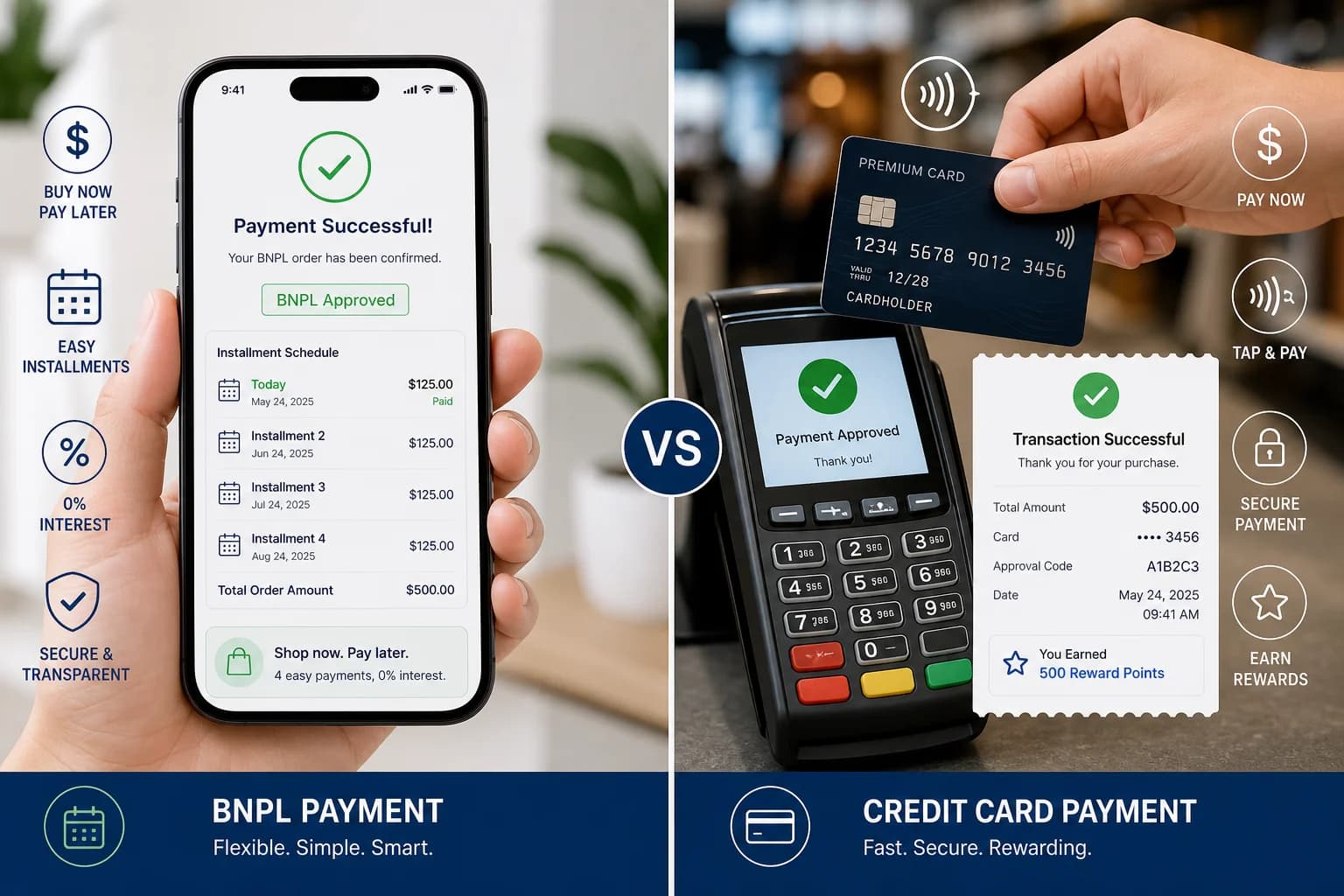
You are at checkout. The total is $650. You have two options: split it into 4 interest-free payments with BNPL, or put it on your credit card and pay it off over time. Both seem reasonable. But which one actually costs less? The answer depends on your specific situation—and most comparison articles will not tell you why. This one will. With U.S. credit card debt hitting a record $1.23 trillion in 2026 and BNPL usage surging among millennials and Gen Z, understanding the real cost difference between these two payment methods has never been more relevant.
The Short Answer (For Skimmers)
Both BNPL and credit cards have their place in your financial toolkit. The right choice depends entirely on your purchase amount, repayment ability, and financial goals. Here is the quick framework:
Use BNPL When:
- Purchase is between $50 and $1,000
- You want fixed payments with zero interest on short-term plans
- You struggle with credit card minimum payment temptation
- You do not need to build credit history
- The merchant offers a genuine 0% interest plan
Use Credit Cards When:
- Purchase is $1,000 or more
- You can pay the full balance before the billing cycle ends
- You want rewards, cashback, or travel points
- You are actively working to build or repair your credit score
- You need strong consumer protection on a major purchase
Avoid Both When:
- You cannot genuinely afford the purchase even with installments
- You have a history of missed payments in the last six months
- You are using one to pay off the other—this creates a dangerous debt cycle
- You feel anxious or pressured about taking on this obligation
Now let us dig into the details so you can make the decision with real numbers, not guesswork.
What Is BNPL? A Quick Primer
Buy Now, Pay Later (BNPL) is a payment model that lets you split purchases into fixed installment payments, typically with no interest if you pay on time. It has become one of the fastest-growing payment methods in the United States, particularly among younger consumers who want flexibility without traditional credit card debt.
How Buy Now Pay Later Works
The most common BNPL structure is the 4-pay plan: you pay 25% of the purchase price upfront and the remaining 75% spread across three equal payments, usually due every two weeks. For example, a $400 purchase would be paid as four payments of $100 each. Most BNPL providers charge zero interest on these short-term plans. Longer-term financing options—typically 6 to 36 months—are available through providers like Affirm and may include interest rates ranging from 0% to 30% depending on your creditworthiness. Most BNPL approvals use a soft credit pull, which does not affect your credit score.
Major BNPL Providers in 2026
The BNPL market is dominated by several key players. Afterpay (now part of Square/Block) is widely accepted at fashion, beauty, and lifestyle retailers. Klarna offers the most retailer partnerships and provides multiple payment structures including pay-in-four and longer financing terms. Affirm is known for transparent pricing with no late fees and is popular for larger purchases at electronics and furniture stores. Zip (formerly Quadpay) works at most retailers that accept Visa. PayPal Pay in 4 is available wherever PayPal is accepted and integrates seamlessly for PayPal users. Apple Pay Later, if available in your region, offers seamless checkout integration for Apple users.
The Business Model (How They Make Money)
Understanding how BNPL companies make money helps explain why they push certain payment options. Their primary revenue comes from merchant fees—typically 2% to 8% of each transaction—paid by retailers who want to offer BNPL at checkout. This is similar to credit card interchange fees. Some BNPL providers also earn interest on longer-term financed plans and charge late fees when consumers miss payments, which are capped by state regulations but can still add up.
What Is a Credit Card? A Quick Primer
A credit card is a revolving credit line that lets you borrow money up to a set limit, make purchases, and pay them back over time. Unlike BNPL's fixed installment structure, credit cards offer much more flexibility—you can carry a balance, pay the minimum, or pay in full each month. That flexibility is useful but also carries risk if not managed carefully.
How Credit Cards Work
Credit cards operate on a billing cycle, typically 30 days. You receive a statement showing your purchases, and you have a due date to pay at least the minimum amount. If you pay your full statement balance by the due date, you pay zero interest—this is called the grace period. If you carry any balance, interest begins accruing at your Annual Percentage Rate (APR). The average credit card APR in 2026 ranges from 21% to 24%, which are record highs according to Federal Reserve data.
Average Credit Card Terms in 2026
- Average APR: 21–24% (new record highs)
- Minimum payment: typically 2–3% of your outstanding balance
- Late fees: $30–$40 for the first late payment, up to $41 maximum under federal regulations
- Rewards: 1–5% cashback or travel points depending on the card
- Sign-up bonuses: ranging from $200 to $1,000+ in value for qualifying spending
The Business Model (How Issuers Make Money)
Credit card issuers make money through multiple streams. The largest is interest income from carried balances—every month you do not pay in full, the issuer earns interest on your outstanding amount. Interchange fees are paid by merchants every time you swipe (typically 1–3% of the transaction). Late fees, penalty APRs triggered by missed payments, and annual fees on premium cards add additional revenue. This business model means issuers benefit when you carry a balance, which is why understanding the terms matters.
Head-to-Head Comparison: 7 Key Factors
Here is how BNPL and credit cards compare across the seven factors that matter most for your wallet.
Factor 1: Total Cost of Borrowing
BNPL cost example on a $500 purchase: With a standard 4-payment plan paid on time, your total cost is $500—zero interest and zero fees. If you miss a payment, expect a late fee of $7–$15 depending on your state and provider. For a 12-month financed option through Affirm or similar with a 15% APR and fair credit, that $500 purchase would cost approximately $540 total.
Credit card cost example on a $500 purchase: If you pay the full balance within the grace period, your cost is $500 plus any rewards earned (potentially $5–$25 in cashback). If you carry the balance at a 22% APR with minimum payments of 3%, you would pay approximately $567 over 12 months, with $67 going purely to interest. A single late payment would add a $30–$40 fee on top.
Winner: Depends entirely on your repayment behavior. If you pay on time and can pay in full, credit cards cost nothing extra. If you need to spread payments over months and cannot pay in full, BNPL short-term plans typically cost less.
Factor 2: Credit Score Impact
BNPL and credit reporting: Most BNPL providers do not report on-time payments to the three major credit bureaus—Equifax, Experian, and TransUnion. This means using BNPL responsibly does not build your credit history. However, missed payments and defaults can be sent to collections, which will damage your credit score. A hard credit inquiry may occur for longer-term financing options, causing a minor temporary dip.
Credit cards and credit reporting: Credit cards report to all three bureaus monthly. Your payment history accounts for 35% of your FICO score, making credit cards a powerful tool for building credit if used responsibly. Credit utilization—how much of your available credit limit you are using—accounts for another 30% of your score. Keeping utilization below 30% is recommended.
Winner: Credit cards, if you pay on time and manage utilization. For building credit from scratch, a secured credit card is one of the most accessible tools available.
Factor 3: Consumer Protections
BNPL protections: Consumer protections for BNPL are currently more limited than credit cards. You do not have the same federal chargeback rights under the Fair Credit Billing Act (FCBA) that credit card users enjoy. Some BNPL providers offer purchase protection programs, but these vary significantly by company and are often buried in terms and conditions. The Consumer Financial Protection Bureau (CFPB) has increased oversight of BNPL providers in recent years, and regulations are evolving, but protections are not yet on par with credit cards.
Credit card protections: Credit cards offer robust consumer protections under the FCBA. If a product is defective, never arrives, or is misrepresented, you can dispute the charge and withhold payment during the investigation. Fraud liability is typically capped at $50—and most major issuers offer $0 fraud liability. Many premium cards also include extended warranty coverage, purchase protection, travel insurance, and rental car collision coverage.
Winner: Credit cards, significantly. For expensive purchases, electronics, travel, or anything where something could go wrong, credit cards offer substantially stronger protection.
Factor 4: Spending Psychology and Overspending Risk
BNPL behavioral risks: One of the biggest dangers of BNPL is psychological. Because BNPL feels less like debt—small fixed payments feel manageable—it can encourage higher spending. Studies indicate that consumers spend 20–30% more when using BNPL compared to paying upfront. Multiple active BNPL plans across different apps create fragmented debt that is easy to lose track of. Autopay can mask cash flow problems because the automatic deduction does not feel like an active decision.
Credit card behavioral risks: Credit cards carry their own psychological risks. The minimum payment trap is real—paying only the minimum extends your debt for years while interest compounds. High credit limits can tempt you to spend beyond your means. Reward structures are designed to encourage more spending. And when you carry balances across multiple cards, total debt becomes harder to track.
Winner: Tie. Both payment methods require self-awareness and discipline. Neither is inherently safer if you do not understand your own spending patterns. Consider tracking your expenses to identify where your money actually goes.
Factor 5: Flexibility and Convenience
BNPL flexibility: BNPL is widely accepted at online retailers and increasingly available in physical stores. Approval is instant at checkout. You get a fixed payment schedule with no surprise bills—knowing exactly what you owe and when. However, you cannot carry a balance indefinitely; the plan ends when you finish paying.
Credit card flexibility: Credit cards are accepted virtually everywhere, both online and offline, domestic and internationally. You can carry a balance as long as needed (though it is expensive), choose your payment amount above the minimum, and access emergency funding when needed. Credit limits can be increased over time with responsible use.
Winner: Credit cards, by a wide margin. The acceptance breadth and ability to manage your own payment timeline make credit cards more flexible for a wider range of situations.
Factor 6: Rewards and Perks
BNPL rewards: Rewards are rare in the BNPL space. Some apps offer points or small discounts at specific partnered retailers, and Klarna occasionally runs cashback promotions. However, there is no meaningful rewards ecosystem comparable to credit cards.
Credit card rewards: Credit cards offer robust rewards programs. Cashback cards typically earn 1–5% on purchases, with category bonuses that can push effective returns even higher. Travel cards earn points or miles worth 1–4 cents each, which can represent significant value for frequent travelers. Sign-up bonuses worth $200 to over $1,000 in value are common for new cardholders who meet minimum spending requirements.
Winner: Credit cards, by far. If you are paying for something anyway, you might as well earn rewards. Just do not spend more just to earn rewards—that defeats the purpose.
Factor 7: What Happens If You Miss Payments?
BNPL late payment consequences: If you miss a BNPL payment, expect a late fee of $7–$15 depending on the provider and your state. Your account will likely be suspended, preventing you from using the service for new purchases until you catch up. If your account goes 30–60 days without payment, it may be referred to collections, which can affect your credit score. Some BNPL providers do not report to credit bureaus at all for late payments, but this is changing as regulations tighten.
Credit card late payment consequences: A late credit card payment triggers a late fee of $30–$40 for a first offense (capped at $41 for 2026 under federal regulations). If you are 60 days late, the issuer may impose a penalty APR of up to 29.99%, which can last six months or longer. After 30 days of being delinquent, the late payment is reported to credit bureaus and your credit score drops. Repeated late payments can result in account closure and legal action for collections.
Winner: BNPL, with lower immediate fees. But note that BNPL late fees, while smaller, can still cascade into collections and credit damage. Neither option is harmless if you miss payments.
Real Cost Scenarios: See Your Numbers
Here are five real-world scenarios showing the actual dollar costs of each payment method. Run your own numbers through these examples to find the scenario closest to your situation.
Scenario 1: $300 Purchase, Paid Off in 6 Weeks
BNPL (4 payments): $0 interest, $0 fees if paid on time. Total cost: $300. You earn no rewards. Credit Card (paid in full): $0 interest. Total cost: $300. If you use a 2% cashback card, you earn $6 back—effectively making it $294. Winner: Credit card, because you earn rewards while paying the same price. The exception: if you are at high risk of carrying a balance, BNPL is safer because it enforces a fixed payoff schedule.
Scenario 2: $800 Purchase, Need 4 Months to Pay
BNPL (4 payments): Some BNPL plans allow extended 4-pay or 6-pay options. If true 0% interest over 4 months: $800 total with no extra cost. Credit Card (minimum payments at 22% APR): Paying only the minimum (2% of $800 = $16/month) at 22% APR means you pay approximately $886 over 4 months—$86 in interest alone. Winner: BNPL, by a significant margin. The fixed payment schedule and zero interest make BNPL the clear winner for short-term installment needs under $1,000.
Scenario 3: $2,000 Emergency Expense, Tight Cash Flow
BNPL: Many BNPL providers have purchase limits and may not approve $2,000 on a single transaction. A 12-month plan at 15% APR would cost approximately $2,165 total ($165 in interest). Credit Card (22% APR, minimum payments): Minimum payments on $2,000 at 22% APR would total approximately $2,500 over time. Credit Card (0% intro APR for 15 months): If you qualify for a 0% intro APR card and pay $2,000 before the promo ends, your total cost is exactly $2,000. Winner: Depends on your credit card terms. A 0% intro APR credit card is the cheapest option if you qualify and are disciplined enough to pay it off before the promo ends.
Scenario 4: Building Credit from Scratch (No Credit History)
BNPL: Most BNPL services do not report on-time payments to the three major credit bureaus. This means you could use BNPL for years and have nothing to show for it on your credit report. Credit Card (secured or student card): Secured credit cards report to all three bureaus monthly. Used responsibly—keeping utilization low and paying on time—your payment history builds your credit score over 6–12 months. Winner: Credit card, and it is not close. If building credit is one of your goals, a secured credit card is one of the most accessible and effective tools available.
Scenario 5: You Have a History of Missing Payments
BNPL: Missed payments result in lower fees ($7–$15) but can still lead to account suspension, collections referrals, and credit damage if sent to collections. Credit Card: Missed payments trigger $30–$40 late fees, potential penalty APR increases, and a credit score drop after 30 days. Repeated misses can cause account closure and legal action. Winner: Neither. If you have a history of missed payments, the most important step is not to take on new debt until you address the underlying cash flow problem. Build an emergency fund to create a financial cushion before you consider either option.
The Hidden Costs Nobody Talks About
Beyond the advertised rates and fees, both BNPL and credit cards have hidden costs that can catch you off guard.
BNPL Hidden Costs
- Multiple BNPL accounts create fragmented debt that is hard to track across apps and providers
- Autopay can cause overdraft fees if your bank account balance is insufficient when payments process
- Returns and refunds can become complicated—your payments may continue while a dispute is being resolved
- Psychological cost: using BNPL for non-essential purchases makes it easier to spend beyond your means
- Some BNPL plans have deferred interest, meaning if you do not pay in full by a specific date, all back interest is charged at once
Credit Card Hidden Costs
- Minimum payment illusion: Only paying the minimum extends your debt for years while interest compounds dramatically
- Foreign transaction fees of 1–3% on international purchases can quietly add up
- Balance transfer fees of 3–5% apply even on promotional 0% offers
- Annual fees on rewards cards range from $95 to $550+ and are charged whether you use the card heavily or not
- Credit card late fees are capped at $41, but penalty APRs of up to 29.99% can last six months or longer after a single late payment
Decision Framework: Which Should YOU Choose?
Use this checklist to determine which payment method fits your situation. Answer honestly—the goal is to match the tool to your actual circumstances, not to force one option.
Choose BNPL If:
- Your purchase is under $1,000
- You can comfortably afford all four payments
- You do not need to build credit history
- You want a fixed schedule with no temptation to carry a balance
- The merchant offers a genuine 0% interest plan with no hidden terms
- You are confident you will not open multiple BNPL plans simultaneously
Choose Credit Cards If:
- You can pay your full balance before the billing cycle ends
- You want to earn rewards, cashback, or travel points
- You are building or actively repairing your credit score
- Your purchase requires strong consumer protections (electronics, travel, large appliances)
- You have the discipline to avoid the minimum payment trap
- Your purchase is $1,000 or more and you need flexible repayment terms
Avoid Both If:
- You cannot genuinely afford the purchase even with installments
- You are planning to use one to pay off the other—this is a debt cycle warning sign
- You have missed payments in the last six months
- You feel anxious or pressured about taking on this financial obligation
- You do not have a handle on your existing debt and cash flow
If you are struggling with existing debt, consider building an emergency fund first to create a financial cushion before taking on new payment obligations.
FAQ: BNPL vs Credit Cards
- Does BNPL affect my credit score?
- Most BNPL providers do not report on-time payments to credit bureaus, so responsible BNPL use will not build your credit. However, missed payments can be sent to collections, which will damage your credit score. Some longer-term financing options may involve a hard inquiry that causes a minor temporary dip.
- Can I build credit with BNPL?
- Generally, no—at least not with most current BNPL providers. Only a few, like certain Affirm loan products, report to credit bureaus. For building credit, a secured credit card or authorized user arrangement is a far more reliable tool.
- What happens if I miss a BNPL payment?
- You will likely be charged a late fee of $7–$15 depending on the provider. Your account may be suspended, preventing new purchases until you catch up. If the account goes 30–60 days without resolution, it may be referred to collections, which can affect your credit score.
- Is BNPL safer than credit cards?
- No. Credit cards offer significantly stronger consumer protections under the Fair Credit Billing Act, including chargeback rights for defective or undelivered products, fraud liability capped at $50 (usually $0 with major issuers), and purchase protection programs. BNPL protections vary by provider and are generally less comprehensive.
- Do BNPL services charge interest?
- Short-term 4-pay plans through most major BNPL providers are typically interest-free if paid on time. Longer-term financing options (6–36 months) through providers like Affirm do charge interest, ranging from 0% to 30% depending on your creditworthiness and the specific plan. Always read the terms carefully.
- Can I use BNPL with bad credit?
- Yes, in most cases. Most BNPL approvals use a soft credit pull that does not affect your credit score. However, bad credit may limit your purchasing power or result in higher interest rates on financed plans. BNPL does not help you build credit, so it does not solve the underlying credit problem.
- Should I pay off my credit card or BNPL first?
- If you have limited funds to put toward debt, prioritize the option with the highest effective interest rate or the one causing the most financial harm. For most people, carrying a high-APR credit card balance is more expensive than a 0% BNPL plan. However, if missing a BNPL payment would immediately trigger collections and credit damage, that may deserve higher priority.
- Are there purchase limits with BNPL?
- Yes. BNPL providers set individual purchase limits that vary by user, purchase history, and provider. First-time buyers typically have lower limits ($200–$500), which can increase with responsible use. Some providers have overall account limits rather than per-transaction limits, which can make managing multiple purchases complex.
The Bottom Line
BNPL and credit cards are both financial tools. Neither is universally better, and both can hurt you if used without understanding the terms. The key is matching the tool to your actual situation—your purchase amount, your ability to repay, whether you are trying to build credit, and whether you need consumer protections. If you want to learn more about building a financial cushion that reduces your need for either option, start with calculating how much emergency fund you actually need.
Both BNPL and credit cards have legitimate uses when handled responsibly. The goal is not to avoid all debt—it is to make borrowing decisions that serve your actual financial goals, not ones that surprise you with hidden costs later.
Take control of your money today
Start free with Spendmate — track expenses, plan budgets, and reach your financial goals.
Start free with Spendmate