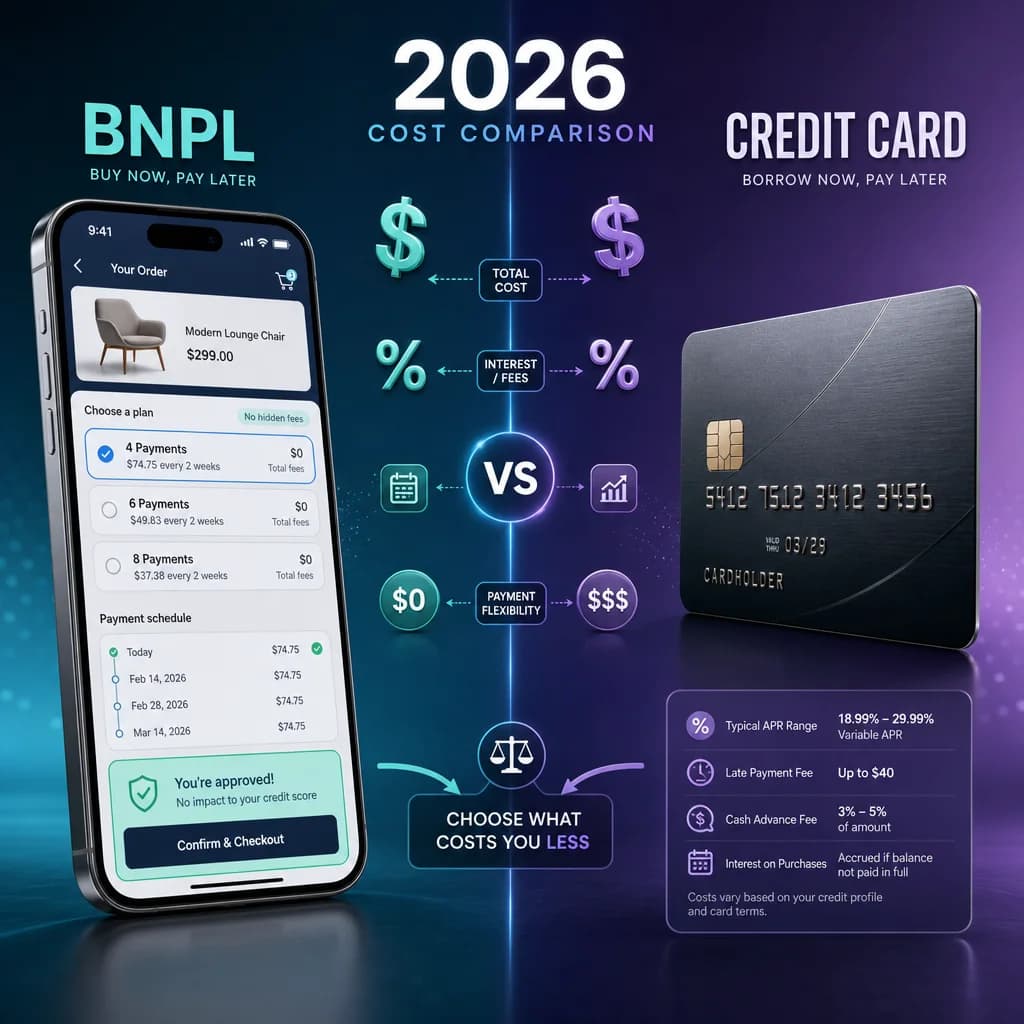
BNPL vs credit cards — which payment method actually saves you money? With US credit card debt at a record $1.23 trillion and BNPL usage exploding across retail platforms, more Americans are facing exactly that question. The answer is not simple — and anyone telling you otherwise is selling something. Here is the real math, the actual risks, and a decision framework based on YOUR financial situation.
The Short Answer — It Depends on Your Situation
Both Buy Now Pay Later (BNPL) services and credit cards can help you build wealth — or destroy it. The difference comes down to your payment discipline, your credit-building goals, and whether you can afford the purchase in the first place. There is no universal winner. But there is a right answer for your specific circumstances.
When BNPL Wins
- You need predictable, fixed payments you can count on every pay cycle
- Credit card minimum payments tempt you, but a structured payoff schedule keeps you honest
- Your purchase falls in the $200–$2,000 sweet spot where BNPL terms work best
- You will pay on time, every time — because missed payments trigger fees immediately
- You want to skip the hard credit inquiry that comes with new credit card applications
When Credit Cards Win
- You pay your balance in full every month and dodge interest entirely
- Rewards, cash back, or travel points on everyday spending appeal to you
- You need strong buyer protection and dispute rights for large purchases
- You are actively building or rebuilding your credit history
- Your purchases exceed $2,000 and you want extended fraud and purchase protection
When You Should Use NEITHER
- You cannot afford the purchase even with installment payments
- You have missed payments on any obligation in the last six months
- You are using one loan to pay off another — a classic debt spiral signal
- It is an emergency expense and you have no emergency fund to draw from
- Taking on this additional payment obligation causes you anxiety or stress
What Is BNPL? (Quick Refresher)
Buy Now Pay Later services let you split a purchase into installment payments, typically four equal payments spread over six weeks. The appeal is simple: no interest if you pay on time, no credit check for most Pay-in-4 plans, and payments that auto-debit from your account.
How Buy Now Pay Later Works
- Select BNPL at checkout and choose a payment plan — most commonly a 4-payment split
- First payment is due immediately at the time of purchase
- Remaining three payments auto-debit every two weeks on a fixed schedule
- Most Pay-in-4 plans charge 0% interest — IF you pay on time
- Some longer-term BNPL financing (6–36 months) does carry interest, ranging from 10–30% APR
Major BNPL Providers in 2026
- Affirm — terms from 3 to 36 months; some plans carry interest, some do not
- Klarna — Pay in 4 (0% interest) plus longer financing options with APR
- Afterpay — 4 payments over 6 weeks; no interest, late fees apply
- PayPal Pay in 4 — 4 payments over 6 weeks; no interest or hidden fees
- Sezzle — 6-week split with 0% interest for on-time payers
Where BNPL Is Accepted
BNPL is accepted at a growing list of online retailers and select in-store locations via QR codes and mobile apps. Major partners include Target, Walmart, Amazon (select sellers), Sephora, Nike, Best Buy, and Home Depot. Acceptance has grown rapidly, though it is still far less universal than credit cards.
What Is a Credit Card? (Quick Refresher)
A credit card is a revolving credit line that lets you borrow up to a set limit, repay over time, and reuse the credit as you pay down the balance. Unlike BNPL's fixed payoff schedule, credit cards give you flexibility — and that flexibility can work for or against you depending on how you use them.
How Credit Cards Work
- You receive a credit limit based on your creditworthiness
- You can make purchases up to that limit and carry a balance month to month
- Minimum payment is required monthly — but paying only the minimum keeps you in debt for years
- Interest accrues on carried balances at your card's APR (Annual Percentage Rate)
- If you pay your full statement balance by the due date, you pay zero interest — the grace period
Key Credit Card Terms to Know
- APR (Annual Percentage Rate) — the interest rate charged on carried balances; average 2026 rate is approximately 23%
- Grace period — the window between your statement close date and due date where paying in full avoids interest
- Minimum payment — the smallest amount due to keep your account current; paying only this leads to long-term debt
- Credit utilization ratio — how much of your available credit you are using; keeping it below 30% protects your credit score
- Statement balance vs current balance — statement is what is due now; current includes pending transactions
Head-to-Head Comparison — The Real Numbers
Numbers tell a clearer story than marketing. Here is how a $1,000 purchase plays out across both options over six months.
Cost Comparison: $1,000 Purchase
- BNPL (Pay in 4) — Total cost: $1,000. Interest: $0 (if paid on time). Time to pay off: 6 weeks. Late fees: $7–$10 per missed payment.
- Credit Card at 20% APR, carrying balance — Total cost: $1,105+. Interest: ~$105 over 6 months. Time to pay off: 6+ months. Late fees: $30–$40 per missed payment.
- Credit Card paid in full monthly — Total cost: $1,000. Interest: $0. Time to pay off: 1 month. No interest charges if discipline holds.
Fee Structure Breakdown
BNPL fees are straightforward: typically $0 interest for Pay-in-4 plans, $7–$10 per missed payment in late fees, and no annual fees. However, longer-term BNPL financing through providers like Affirm can carry 10–30% APR, and some plans include deferred interest — meaning if you do not pay in full by a set date, you get charged retroactive interest on the entire original amount.
Credit card fees are more complex and stack up faster. Interest runs 15–29% APR depending on your credit profile, late fees hit $30–$40 per occurrence, annual fees range from $0 to $550+ for premium cards, foreign transaction fees add 0–3% on international purchases, and balance transfer fees typically run 3–5%. The complexity itself is a risk — it is easy to overlook a fee until it has already cost you money.
Credit Score Impact — The Critical Difference
Your credit score is not just a number — it affects your ability to rent an apartment, get a car loan, qualify for a mortgage, and even land certain jobs. Here is how each payment method affects yours.
How BNPL Affects Your Credit
- Most Pay-in-4 services use soft inquiry only — no impact when you apply
- Some BNPL providers now report on-time payments to credit bureaus, which can build credit
- Missed BNPL payments may be reported and can damage your score significantly
- BNPL does not affect your credit utilization ratio — there is no revolving credit line being tracked
- Limited credit-building benefit compared to traditional credit products
How Credit Cards Affect Your Credit
- Hard inquiry on application — typically drops your score 5–10 points temporarily
- Payment history is 35% of your FICO score — paying on time is critical
- Credit utilization ratio is 30% of your score — keeping balances below 30% of your limit is essential, and below 10% is ideal
- Length of credit history is 15% of your score — older accounts help
- Credit mix and new credit each account for 10% of your score
Which Builds Credit Faster?
Credit cards win for building credit — if used responsibly. The consistent reporting cycle, utilization tracking, and longer account history give credit bureaus more data to work with. That said, BNPL is evolving: some providers now report positive payment history, though widespread adoption is still limited. If building credit is your priority, a responsibly used credit card will get you there faster than most BNPL products.
Risk Comparison — Where People Actually Get Hurt
Both tools can cause real financial damage when used poorly. Here is where the danger points are for each.
BNPL Risks
- Overextension — it is easy to open multiple BNPL loans simultaneously across different apps, losing track of total owed
- No centralized statement — there is no single monthly view of everything you owe across BNPL providers
- Missed payment fees add up fast — $7–$10 per missed payment per loan can become hundreds per year
- Deferred interest traps — some BNPL plans charge retroactive interest on the full original amount if not paid in full by deadline
- Limited consumer protections — fewer dispute rights compared to credit cards, and merchant refunds may not stop upcoming scheduled payments
Credit Card Risks
- Revolving debt trap — minimum payments keep you in debt for decades; a $1,000 balance at 23% APR paid only with minimums takes over 7 years to clear and costs $800+ in interest
- High APR compounding — 20–29% interest compounds quickly on carried balances
- Credit utilization damage — high balances relative to your limit can drop your score by 30–50 points
- Fee stacking — late fees, over-limit fees, and cash advance fees compound on top of existing debt
- Temptation to overspend — a high credit limit can feel like "available money" rather than borrowed funds
The Debt Spiral Warning
According to 2026 CFPB data, 41% of BNPL users admit to overspending because of these services. Meanwhile, 52% of credit card holders carry debt month to month. Using BNPL and credit cards simultaneously for different purchases compounds the problem — you lose visibility into your total debt exposure. The red flag is always the same: taking out new loans to pay existing ones.
Decision Framework — Choose Based on YOUR Situation
Use this checklist to decide which tool — if any — is right for your purchase.
Use BNPL If...
- You can afford the full purchase but want cash flow flexibility for the next six weeks
- You will absolutely pay every installment on time — no exceptions
- The purchase is between $200–$2,000, which is the BNPL sweet spot
- You do not need credit-building assistance right now
- You value predictable, fixed payments rather than revolving credit
- You tend to overspend when using traditional credit cards
Use Credit Cards If...
- You pay your statement balance in full every single month — avoiding all interest
- You want to earn rewards, cash back, or travel points on your spending
- You are actively building or rebuilding your credit history
- You want strong buyer protection and dispute rights for your purchases
- The purchase is large (over $2,000) and you need extended fraud and purchase protection
- You travel internationally and need a card with no foreign transaction fees
Use NEITHER If...
- You cannot genuinely afford the purchase even with installment payments
- You have missed payments on any obligation in the last six months
- You are using debt to cover basic living expenses like rent or groceries
- You have no emergency fund and this is an emergency purchase — consider building an emergency fund first
- You feel anxiety or stress about taking on this additional financial obligation
Hybrid Strategy — Using Both Smartly
The most financially sophisticated users often use both tools strategically, but only when each is deployed in its strongest lane. The key rule: never use both simultaneously for the same purchase category.
The Strategic Approach
- Use credit cards for daily spending — groceries, gas, subscriptions — and pay in full monthly to earn rewards with zero interest
- Use BNPL selectively for specific large purchases (like a $1,200 laptop) where 0% Pay-in-4 applies and it helps manage cash flow
- Track all your obligations — BNPL plans, credit card balances, loan payments — in one place using a budgeting app to maintain full visibility
- Never roll over BNPL payments or carry credit card balances as a habit — they are tools, not income sources
Example Scenario
Your monthly groceries and gas: credit card paid in full (earns 2% cash back). Your new laptop at $1,200: BNPL Pay-in-4 over six weeks (keeps cash flow flexible without interest). Emergency car repair: drawn from your emergency fund — not charged to either. This is what a smart hybrid strategy looks like in practice. If you do not yet have an emergency fund, start building one with our emergency fund guide — it is the buffer that keeps you from needing to use either tool for genuine emergencies.
Common Mistakes That Cost Real Money
- Opening multiple BNPL loans simultaneously across different apps — you lose track of total obligations fast
- Making only minimum credit card payments — this traps you in debt for years and costs thousands in interest
- Using BNPL for consumables — clothes, meals, and subscriptions that provide no lasting value beyond the moment of purchase
- Ignoring BNPL late fees — $10 here, $7 there compounds into hundreds of dollars per year
- Not reading the fine print — some "0% interest" plans include deferred interest clauses that hit you with full retroactive interest if you miss the payoff deadline
- Using credit cards for cash advances — these carry immediate interest, no grace period, and high fees
- Closing old credit cards after paying them off — this shortens your credit history and can hurt your score
FAQ — BNPL vs Credit Cards
- Does BNPL affect my credit score?
- Most Pay-in-4 BNPL plans use soft inquiry only and do not affect your score. However, some longer-term BNPL plans and missed payment reporting can impact your credit. Check your specific provider's reporting practices before assuming.
- Can I build credit with BNPL?
- Limitedly. Some BNPL providers now report positive payment history to credit bureaus, but it is not yet as established or comprehensive as credit card reporting. For reliable credit building, credit cards remain the stronger tool.
- What happens if I miss a BNPL payment?
- You will likely face a late fee of $7–$10 per missed payment per loan. The payment plan may be cancelled and the full remaining balance could become due immediately. Missed payments may also be reported to credit bureaus, damaging your score.
- Is BNPL considered debt?
- Yes, technically. Any money you owe is a debt. The difference from credit card debt is that BNPL installment plans typically have a fixed payoff date and no interest — but the obligation to pay remains real and legally binding.
- Do BNPL services do hard credit checks?
- Most Pay-in-4 plans use soft inquiry only. However, BNPL financing options with longer terms (6–36 months) typically involve hard inquiries, especially for higher amounts.
- Can I pay off BNPL early without penalty?
- Yes — unlike many credit products, BNPL typically allows early repayment with no prepayment penalties. Paying early can also help you avoid the risk of missed future payments.
- Which is better for bad credit: BNPL or a secured credit card?
- A secured credit card, used responsibly, is generally better for rebuilding credit because it reports consistently to bureaus and builds a payment history. BNPL's limited reporting makes it less effective for credit building.
- Are BNPL purchases protected like credit card purchases?
- Less so. Credit cards offer robust dispute rights and purchase protection under the Fair Credit Billing Act. BNPL protections vary by provider and are generally less standardized. Always check the specific merchant's return and dispute policy before purchasing.
- What if I need to return a BNPL purchase?
- Refunds can be complicated. If you return an item purchased with BNPL, the refund may not automatically stop your scheduled payments. You may need to manually confirm the refund is applied and that your payments stop — do not assume it happens automatically.
- Should I use BNPL or credit card for holiday shopping?
- If you can pay in full within the BNPL 6-week window, Pay-in-4 is interest-free. If you need longer than six weeks to pay, use a credit card paid in full monthly — but only if you have a history of paying off your balance. Do not use either for gifts you cannot genuinely afford.
Final Take — Make the Choice That Serves Your Goals
BNPL and credit cards are tools. Like any tool, they are only as good as the plan behind their use. If you are financially disciplined, pay on time, and want rewards or credit-building potential — credit cards are the stronger choice. If you need a structured, short-term payment plan and will definitely pay every installment — BNPL can work for you without costing a cent more than paying cash.
The worst outcome is using both carelessly and losing track of what you owe. Track every obligation, keep your utilization low, and always know your payoff date. Financial confidence comes from understanding exactly where your money goes — not from hoping the math works out.
Take control of your money today
Start free with Spendmate — track expenses, plan budgets, and reach your financial goals.
Start free with Spendmate