
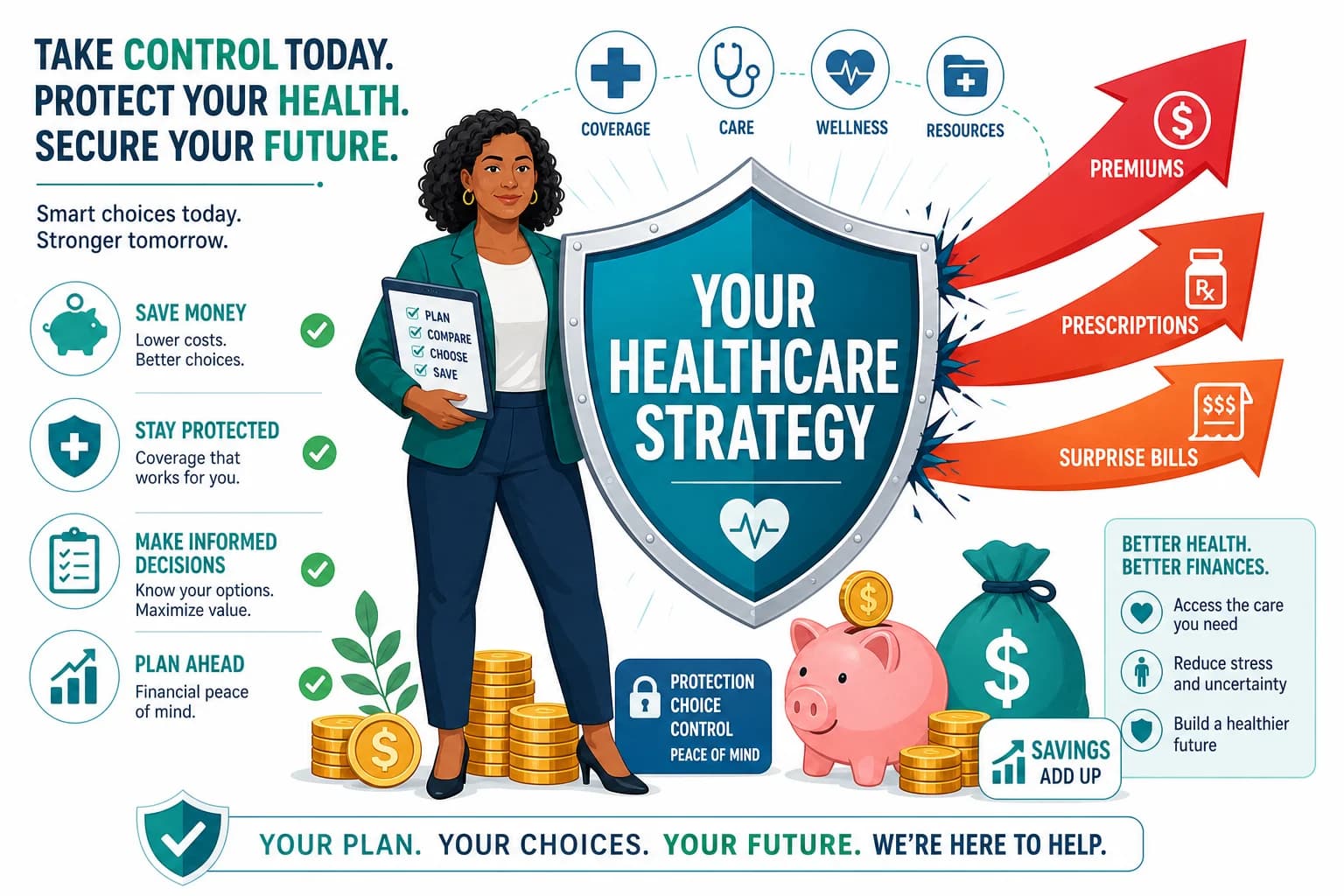
Here is the frustrating truth: Healthcare costs in America are rising faster than wages, inflation, and common sense. The empowering truth: You are not powerless. Millions of Americans overpay for healthcare by 20-40% simply because they do not know these 15 tactics exist. From slashing prescription costs to negotiating hospital bills, from maximizing employer benefits to leveraging federal protections — this guide gives you the exact steps to save hundreds to thousands annually without sacrificing the quality of your care.
The Short Answer: Yes, You Can Lower Healthcare Costs Safely
Most Americans overpay for healthcare without realizing it. The good news is that proven strategies exist across three areas — insurance optimization, prescription costs, and bill negotiation — that can collectively save a typical household $1,000-$5,000 or more per year. You do not need to skip necessary care or sacrifice quality to reclaim that money. You just need to know what to ask for and when.
- Tactics 1-5: Insurance Optimization — save $500-$3,000 per year
- Tactics 6-10: Prescription Cost Reduction — save $200-$1,500 per year
- Tactics 11-15: Bill Negotiation and Navigation — save $300-$2,000 per year
Before diving in, note that this guide focuses on actionable steps anyone can implement now, regardless of insurance type or income level. Every tactic here has been verified against current 2026 pricing, federal protections, and real-world outcomes.
Insurance Optimization (Tactics 1-5)
Your health insurance plan is not a set-it-and-forget-it commitment. The decisions you make during enrollment — and throughout the year — directly determine how much you pay for coverage and care.
Tactic 1: Shop During Open Enrollment — Do Not Auto-Renew
Seventy percent of employees auto-renew their health plan without comparing options. This is one of the most expensive inertia habits in personal finance. Your employer's plan options can change dramatically from year to year — premiums shift, provider networks change, and new HSA-eligible plans may become available.
- Mark open enrollment on your calendar: typically November for most employer plans
- Compare total cost — not just the premium — across all available plans: calculate premium + deductible + out-of-pocket maximum for each option
- If you are healthy and rarely need care, a High-Deductible Health Plan (HDHP) paired with a Health Savings Account (HSA) can reduce your premium by $50-$200 per month while providing tax advantages
- Use your employer's plan comparison tool or ask HR for the written summary of benefits for each plan
Savings potential: $500-$2,000 per year just by choosing the right plan structure for your actual usage pattern.
Tactic 2: Maximize Employer Wellness Programs
Most large employers offer wellness programs that include financial incentives — yet the majority of employees never use them. These programs are essentially free money sitting on the table.
- Check your HR portal for wellness incentives: biometric screenings ($100-$500 premium discounts), gym membership reimbursements ($200-$600 per year value), smoking cessation programs, and weight loss support
- Complete required health assessments — these are often the gateway to premium discounts
- If your employer offers a HSA contribution match, treat it as a guaranteed return on investment and max it out
- Some employers offer up to $1,500 per year in wellness rewards — more than enough to cover a family emergency fund contribution
Savings potential: $200-$800 per year in premium discounts and reimbursements, plus employer HSA match dollars.
Tactic 3: Use In-Network Providers Exclusively
Out-of-network care costs 2-5 times more than in-network care — and surprise balance bills from out-of-network providers are a leading cause of medical debt. A single out-of-network emergency room visit can result in a bill exceeding $10,000 before insurance kicks in.
- Before every appointment, verify provider network status by calling both your insurance company AND the provider's office directly
- Ask for the confirmation number documenting in-network status — this protects you if a billing dispute arises later
- For planned procedures, request a written network status confirmation from all providers involved (surgeon, anesthesiologist, lab, facility)
- Use your insurer's provider search tool as a starting point, but always confirm by phone — network directories go out of date quickly
Savings potential: Avoids $1,000-$10,000+ in surprise balance bills from a single out-of-network encounter. For a family with multiple healthcare encounters per year, staying in-network consistently can mean the difference between a manageable deductible and a five-figure medical crisis.
Tactic 4: Leverage Telehealth for Minor Issues
Telehealth has become a mainstream healthcare channel, yet many insured Americans still default to in-person visits for conditions that do not require physical examination. Telehealth copays are typically $0-$30 versus $40-$80 or more for an in-person primary care visit.
- Use your insurance plan's preferred telehealth platform (Teladoc, Doctor On Demand, Amwell, or your employer's specific vendor)
- Best uses for telehealth: minor illnesses (cold, flu, UTIs), prescription refills for stable conditions, mental health counseling, follow-up appointments, and dermatology consultations
- Avoid telehealth for: conditions requiring physical examination, emergencies, or procedures
- Many plans now offer unlimited telehealth visits at no additional cost — check if your employer has expanded this benefit in 2026
Savings potential: $20-$50 per visit. If your family uses telehealth just 6 times per year instead of in-person visits, that is $120-$300 in direct copay savings — plus you avoid facility fees.
Tactic 5: Time Elective Procedures Strategically
Health insurance deductibles typically reset on January 1st for most employer plans. Understanding your deductible status can mean the difference between paying full price and paying nearly nothing for the same procedure.
- If you have already met your deductible for the year: schedule elective procedures before December 31st to maximize your in-network coverage
- If you have not met your deductible: scheduling in January gives you the full year to naturally accumulate deductible payments toward your annual maximum
- Always request a written cost estimate before scheduling — compare the facility fee, physician fee, and anesthesia costs separately
- Ask the billing department about cash-pay discounts for procedures not yet scheduled (see Tactic 12)
Savings potential: $500-$2,000+ depending on the procedure. A minor surgery that costs $3,000 at full price might cost $300 if you have already met your deductible. Timing alone can save thousands.
Prescription Cost Reduction (Tactics 6-10)
Prescription drug costs in the United States rose 12% year-over-year as of 2026, making medication affordability a growing challenge for millions of families. These five tactics address every angle of prescription savings — from asking the right questions at your doctor's office to leveraging assistance programs you may qualify for without knowing.
Tactic 6: Always Ask for Generic Alternatives
Generic medications cost 80-85% less than their brand-name equivalents, yet many patients never ask if a generic option exists. The question takes five seconds and can transform a $300 monthly prescription into a $15 one.
- Ask your doctor: Is there a generic version of this medication available?
- If no generic exists, ask: Is there a therapeutic alternative in the same medication class that might be more affordable?
- Use the FDA Orange Book (available free at orangebook.fda.gov) to verify generic equivalents for any brand-name drug
- Note: Generics must meet the same FDA standards as brand-name drugs for safety, strength, and effectiveness — there is no quality trade-off
Savings potential: $50-$300 per month per medication switched to generic. For someone taking three prescriptions, that is $1,800-$10,800 per year.
Tactic 7: Compare Pharmacy Prices — They Vary Up to 10x
The same prescription can cost $15 at Costco and $150 at a chain pharmacy — for the identical medication, from the same manufacturer, with the same dosage. Pharmacy price transparency tools have made it possible to find the lowest price in your area in under two minutes.
- Use GoodRx, SingleCare, or RxSaver apps to compare prices across pharmacies in your ZIP code
- Warehouse clubs like Costco and Sam's Club often have the lowest prescription prices, even for non-members
- Independent pharmacies may negotiate prices — always ask: Is this the best price you can offer?
- Mail-order pharmacies through your insurance can offer 90-day supplies at 30-day prices — ask your insurer about mail-order options
Savings potential: $10-$135 per prescription. For chronic medications taken monthly, that is $120-$1,620 per year per medication.
Tactic 8: Use Prescription Assistance Programs
Over 1,500 prescription assistance programs exist in the United States, yet the majority of eligible patients never apply. These programs — offered by pharmaceutical companies, non-profits, and state governments — can provide medications at little to no cost for those who qualify.
- Start with NeedyMeds (needymeds.org) — a comprehensive database of every patient assistance program available
- Check Medicare Extra Help (Low Income Subsidy) if you are on Medicare: can reduce prescription costs from $35 to $9.85 or less per drug
- State Pharmaceutical Assistance Programs (SPAPs) exist in 40+ states — check your state's program at nashipadvisor.org
- Patient Advocate Foundation (patientadvocate.org) offers case management for patients facing high medication costs
Savings potential: $100-$5,000+ per month depending on medication and eligibility. For expensive specialty medications that can cost $10,000+ per month, assistance programs can eliminate the entire cost.
Tactic 9: Split Pills When Legal and Safe
Many prescriptions are available in double-strength doses at little to no additional cost. If your doctor approves, splitting pills can effectively cut your medication cost in half while delivering the same active ingredient.
- Ask your doctor: Is this medication available in a higher dose that could be split? Not all pills are safe to split — extended-release, enteric-coated, and certain other formulations should never be split
- Pill splitters cost $3-$10 and are available at any pharmacy
- Only split pills when you have a clear understanding of the correct dosage — never split without explicit doctor approval
- Common pills safe to split: Lisinopril, Metoprolol, Simvastatin, Amitriptyline, and many antidepressants
Savings potential: 30-50% per prescription. If your $100/month medication can be safely split from a higher dose, your cost drops to $50/month — $600 per year.
Tactic 10: Challenge High-Cost Medications with Your PBM
Pharmacy Benefit Managers (PBMs) are the invisible middlemen who determine which medications are covered and at what price. If a medication is denied or priced prohibitively high, appealing directly to your PBM can sometimes result in exceptions.
- Request a formulary exception if your prescribed medication is not covered or is in a high-cost tier: cite clinical necessity and cheaper alternatives that have failed
- If your PBM denies coverage, you can request an external review through your state insurance commissioner — this is a federally protected right
- Document all communication with your PBM: names, dates, reference numbers, and specific promises made
- Employer-funded PBMs may allow your HR department to override coverage decisions for specific employees — escalate to HR if needed
Savings potential: $500-$10,000+ for a single prescription approved through exception. If you take a specialty medication costing $5,000/month and get it covered, that is $60,000 per year.
Bill Negotiation and Navigation (Tactics 11-15)
Medical bills are not always as fixed as they appear. In fact, most hospitals and providers have significant flexibility in pricing, and the federal No Surprises Act has given patients powerful new tools to challenge incorrect charges.
Tactic 11: Request an Itemized Bill and Audit Every Charge
Studies estimate that 80% of medical bills contain errors, and these errors almost always inflate your bill upward. Requesting an itemized bill is your first line of defense against overcharges.
- Always request an itemized bill (not just a summary) from any hospital or provider visit
- Look for common errors: duplicate charges, services not rendered, incorrect billing codes, and items billed at higher rates than your insurance contracted
- Use a medical billing advocate (typically contingency-based at 25-35% of savings) to audit complex bills: find one at medicalbillingadvocates.org
- If you find errors, dispute in writing with the billing department and your insurance company simultaneously
Savings potential: $200-$5,000+ depending on the errors found. For major hospitalizations, medical billing advocates have recovered $10,000-$50,000 or more from single billing cycles.
Tactic 12: Negotiate Cash-Pay Prices Before Services
Cash-pay patients often pay less than insured patients because they can negotiate directly without involving insurance bureaucracy. If you are uninsured or facing a procedure your insurance does not cover, cash negotiation is essential.
- Ask: What is your cash-pay discount for this procedure? Many facilities offer 30-50% reductions for upfront cash payment
- Get quotes from at least 3 providers before committing — prices for the same procedure can vary by 400%+ in the same metro area
- If using insurance, ask if the provider offers a payment plan for amounts not covered by insurance
- For planned procedures, ask for a written binding price quote before services are rendered — do not sign any forms agreeing to pay market rate
Savings potential: 30-50% on planned procedures. A $10,000 surgery could become $5,000-$7,000 with cash negotiation — saving $3,000-$5,000 on a single procedure.
Tactic 13: Use the No Surprises Act Protections
The No Surprises Act (NSA), effective January 2022, protects patients from surprise balance bills in specific scenarios: out-of-network emergency care, out-of-network ancillary services at in-network facilities, and care at out-of-network providers at in-network facilities without patient consent.
- If you receive a surprise bill in a covered scenario under the NSA, you have the right to initiate a dispute resolution process at no cost to you
- File a complaint with the No Surprises Help Desk (1-800-985-3059) or through CMS.gov/nosurprises if your provider bills you in violation of the NSA
- Keep all documentation: Explanation of Benefits (EOB), bills, and any consent forms you signed (or did not sign)
- Note: The NSA does not cover out-of-network ground ambulance services — these remain a significant source of surprise bills
Savings potential: Eliminates 100% of qualifying surprise bills. A $15,000 out-of-network emergency room visit that would normally be your responsibility could be resolved at in-network rates, saving $10,000+.
Tactic 14: Negotiate Payment Plans for Medical Debt
If you cannot pay a medical bill in full, negotiating a payment plan prevents the account from going to collections and damaging your credit score. Most hospitals have financial assistance policies and are willing to set up interest-free payment plans.
- Call the hospital or provider billing department before the due date and explain you cannot pay in full: request a payment plan
- Ask to speak with a financial counselor or patient advocate — they have authority to reduce balances and set up extended payment arrangements
- Negotiate for interest-free installments: most providers will not charge interest on payment plans if you ask
- If you can pay a lump sum, offer 30-50% of the total balance as a settlement — many providers accept this rather than risk no payment
Savings potential: Avoids interest charges (which can be 18-25% APR on medical debt), and potentially reduces total balance by 30-50% through lump-sum settlement offers.
Tactic 15: Shop for Imaging and Lab Work Independently
The same MRI can cost $400 at an independent imaging center and $4,000 at a hospital — even with the same equipment and comparable radiologists. Hospital facility fees are the primary driver of this price differential.
- For non-emergency imaging (MRI, CT, ultrasound) and lab work, search independent facilities first: Solv Health, Scan.com, and ClearScript all offer transparent pricing
- Ask your doctor for a generic lab order so you can take it to any certified lab — this gives you freedom to shop by price
- Freestanding imaging centers are often 50-80% cheaper than hospital-based imaging for identical services
- If your insurance has a narrow network, confirm the independent facility is in-network before booking
Savings potential: $300-$3,000+ per imaging study. A typical MRI that costs $3,500 at a hospital might cost $600-$1,200 at an independent center — saving $2,300-$2,900 on one test.
Summary: Your Healthcare Cost Reduction Checklist
These 15 tactics cover every major area where Americans overpay for healthcare. Start with the tactics that require the least effort and move up the list as you build momentum.
- Shop your insurance during open enrollment — do not auto-renew
- Activate every wellness benefit your employer offers
- Stay in-network for every healthcare encounter
- Use telehealth for minor conditions
- Time elective procedures to your deductible calendar
- Always ask: Is there a generic version of this medication?
- Compare pharmacy prices before every fill
- Apply for prescription assistance programs if you take expensive medications
- Split pills when your doctor approves
- Appeal PBM denials with clinical documentation
- Audit every medical bill for errors
- Negotiate cash-pay prices before non-emergency procedures
- Invoke No Surprises Act protections for qualifying bills
- Set up interest-free payment plans rather than paying collections
- Use independent imaging and lab facilities for non-emergency needs
The strategies in this guide can collectively save a typical household $1,000-$5,000 or more per year. The key is taking action: making one phone call, asking one question, comparing one price. Each small step compounds into significant annual savings without sacrificing the quality of care you and your family deserve.
Take control of your money today
Start free with Spendmate — track expenses, plan budgets, and reach your financial goals.
Start free with Spendmate